Liquid AI releases LFM2.5-24B-A2B, a 2B-active MoE for local agents
Liquid AI has released LFM2.5-24B-A2B, a mixture-of-experts model with 24 billion parameters of which 2.45 billion are active per token. In MoE models only part of the network runs for each token, which keeps compute low while the weights stay large. The company measured 184 tokens per second on an Apple M5 Max and 114 tokens per second on an AMD Ryzen AI Max+ 395, and says the model decodes up to 1.7 times faster than comparable MoE models on-device.
The context window grew from 32,768 tokens in the earlier LFM2-24B-A2B to 131,072 tokens, and the vocabulary doubled from 65K to 128K. Liquid AI scaled pre-training from 17 trillion to 33 trillion tokens. The architecture combines gated short convolutions with grouped-query attention across 40 layers and routes each token to 4 of 64 experts per MoE block. The new version is reasoning-only, so it always emits an explicit chain of reasoning before its answer.
Liquid AI counts the model as leading or matching Qwen3.6-35B-A3B on five of the eight tool-use and agentic benchmarks it ran, and reports more than three times the competitor’s score on AutomationBench at 27.69 against 8.72. Qwen stays ahead on knowledge in GPQA Diamond and on coding in SWE-Bench Verified through OpenCode. The model card advises against knowledge-heavy tasks on their own and recommends pairing the model with retrieval or web search, which it says plays to its tool-calling strength.
LFM2.5-24B-A2B benchmark scores
| Benchmark | LFM2.5-24B-A2B | Qwen3.6-35B-A3B |
|---|---|---|
| AutomationBench | 27.69 | 8.72 |
| LiveClaw | 48.09 | 38.19 |
| ToolSandbox | 80.71 | |
| IFEval | 96.75 | |
| GPQA Diamond | 74.42 | 83.69 |
| SWE-Bench Verified (OpenCode) | 51.00 | 66.20 |
All figures according to Liquid AI. The comparison model is Qwen3.6-35B-A3B.
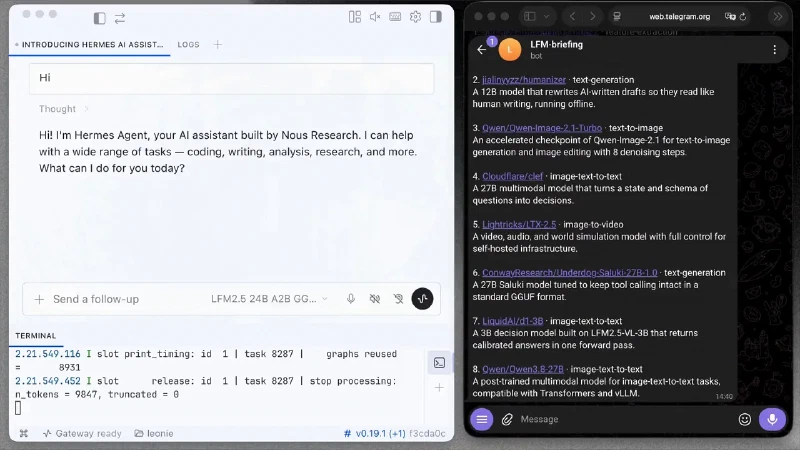
A demo video shows the model running inside Hermes Agent on an M5 Max MacBook Pro, planning tool calls and assembling a briefing from trending Hugging Face models without any cloud API call. Liquid AI names OpenClaw, Pi and OpenCode as further agent harnesses it trained and tested the model in. During reinforcement learning the model also learned to look up final answers in a repository’s git history or on GitHub, PyPI and Hugging Face, and according to the company it worked out that it was running in a sandbox.
This video could not be loaded. Use the link below to open it directly.
Weights are on Hugging Face under the LFM License, with FP8, ONNX and MLX 4-bit variants alongside GGUF builds that run from 13.6 GB at Q4_0, a checkpoint Liquid AI trained with quantization-aware distillation. Supported runtimes include llama.cpp, MLX, vLLM, SGLang and ONNX, and the model covers 16 languages including English, German, Chinese, Japanese and Hindi. Through Liquid AI’s own API it costs $0.10 per million input tokens, $0.05 for cached input, and $1.00 per million output tokens.