Mobile AI news ticker

Tuesday 22 September 2026

Qualcomm's Snapdragon X Elite powers the first Googlebook laptops from Dell and HP

Qualcomm says the Snapdragon X Elite powers the first Googlebook laptops, Google’s new laptop category built around its Gemini Intelligence features. According to Qualcomm’s release, the chip provides all-day battery life, NPU-powered tools and connectivity with Android phones. Google’s own announcement says Googlebook runs millions of Android apps, many of them optimized for large screens, mouse and keyboard input. The Snapdragon models are the Dell XPS Googlebook 13 and the HP Googlebook 14.

The Snapdragon X Elite has 12 Oryon CPU cores and a Hexagon NPU rated at 45 TOPS, according to Tom’s Hardware, which Qualcomm has called the fastest NPU for laptops. Dell says the XPS Googlebook runs its local Gemini Intelligence features, including Magic Pointer and Rambler, on that NPU. Magic Pointer brings up Gemini when the user wiggles the cursor over something on screen, and features such as Cast My Apps and Continue On hand tasks and phone apps over between an Android phone and the laptop.

Pre-orders are open, with devices reaching US shelves on October 4 and Canada, the UK, Ireland, France, Germany and Australia a day later, according to Google. Dell prices the XPS Googlebook 13 with 16 GB of RAM and 512 GB of storage starting at $999, while HP prices the Googlebook 14 starting at $1,199.99. Acer, ASUS and Lenovo also build Googlebooks, and Google puts the lineup’s entry price at $899.
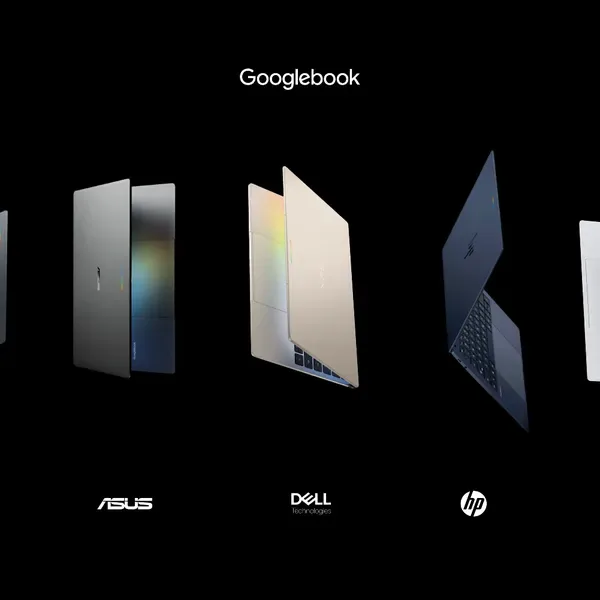
Five Googlebook laptops from Asus, Dell and HP shown open at angles against a black background, with more devices cropped at both edges
Google's own lineup image for the Googlebook launch, showing devices from several of its five hardware partners. Credit: Google

Saturday 19 September 2026

OPPO unveils ColorOS 17 with an on-device linear-attention model and 128K context

OPPO presented ColorOS 17 at its developer conference in Zhuhai, with an on-device large language model built on what the company calls its first Linear Attention architecture. Linear attention keeps compute cost proportional to the length of the input instead of growing quadratically. OPPO says the model supports 128K context natively, uses 48% less memory and 55% less energy than the previous generation, and keeps user data on the device while responding faster.

The on-device model is part of AndesGPT — OPPO’s proprietary large model trained independently and available in sizes from around 1 billion to over 100 billion parameters, deployed in OPPO’s “1+N” end-cloud architecture (a central large model plus specialized smaller models per task). AndesGPT was the first Chinese on-device LLM to register with the Cyberspace Administration on July 15, 2026, alongside Apple Intelligence, Huawei Xiaoyi, vivo BlueLM, Xiaomi HyperAI, Samsung Galaxy AI and ZTE Nubia Doubao.

The update also brings Persona X, a memory engine that builds on data, environmental and behavioral perception and records, forgets and reflects on what it learns about the user. The Xiao Bu assistant (Breeno outside China) gets longer context and better intent recognition. OPPO reports a 19% gain in internal satisfaction testing with device-cloud collaboration, and the assistant can now open 200 Alipay services, plan routes in Tencent Maps and place WeChat messages and calls by voice command.

ColorOS 17 ships first on the upcoming Find X10 series and OnePlus 16, and OPPO, OnePlus and Realme are upgrading in sync. According to Gizmochina, the rollout to existing devices in China starts on October 8 with the Find X9 series and Find N6. The Find X8 series, Find N5 and tablets follow on October 16, and older flagship and mid-range devices from November 26. No global timeline has been announced.

vivo previews BlueCode phone coding agent and researches a 30B MoE on-device model

vivo has released a preview version of BlueCode, a native coding agent that lets users complete software development tasks on the phone itself. The company presented it at its developer conference in Shenzhen and describes the goal as turning phones from content consumption terminals into productivity tools. The reports name no supported devices, release date or technical details for the preview.

vivo is also researching a 30B-parameter BlueLM MoE model for on-device use, according to Tencent News. MoE means the model is split into expert sub-networks and only part of it is active per token. Vice President Zhou Wei said the research aims to explore trillion-scale model applications on phones, and that memory and compute are the main barriers to running large models on them. If model capability improves substantially, each load would need only about 3 to 12 GB of memory, the report quotes him as saying.

The 30B model sits next to the BlueLM lineup that vivo announced at the same event, which has four models for speech (BlueLM-RealTime), on-device use (BlueLM-Nano) and the cloud (BlueLM-Flash and BlueLM-Pro). According to NetEase, BlueLM-Nano handles local perception and personal memory on the device. vivo also launched OriginOS 7, and BlueOS 4 arrives on the vivo WATCH 6.

Friday 18 September 2026

Arm recaps Arm Create China and shows Qwen3-TTS 0.6B running on a vivo X300 CPU

Arm has published five developer takeaways from Arm Create, its developer events in Shanghai and Shenzhen. Two of them concern on-device AI. Arm says model choice starts with the workload and not with model size alone, and that developers should decide which parts of an application stay on the device, which run on nearby edge infrastructure and which need the cloud. The Shenzhen panel included Alibaba Qwen, ModelBest, Tencent Hunyuan and Ultralytics.

In the Shanghai keynote, Shantu Roy, Arm’s VP of Developer Relations, discussed the Arm AI Portal. Arm says the portal lists models validated and optimized for Arm-based platforms, together with performance data for specific targets, code and deployment workflows. Coding agents can reach the same information through the Arm MCP Server.

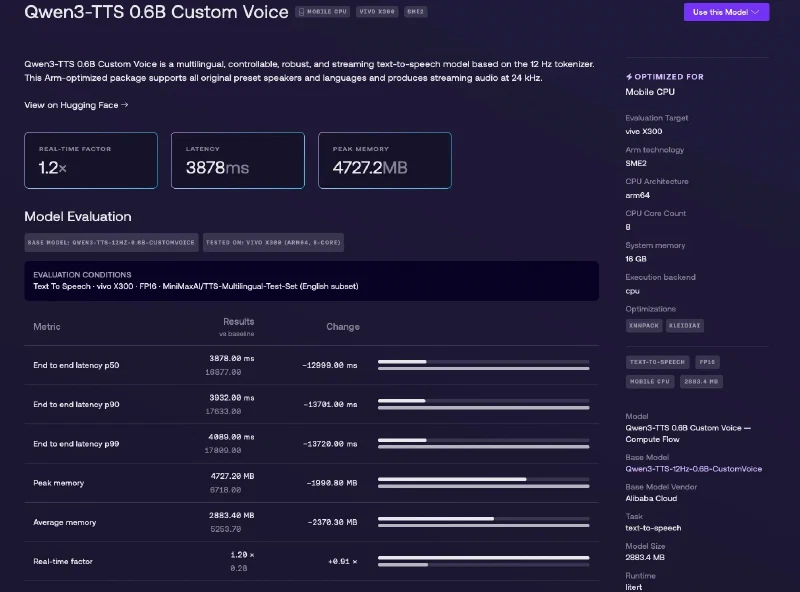
The recap shows the portal’s evaluation of Qwen3-TTS 0.6B Custom Voice, a multilingual streaming text-to-speech model from Alibaba, on a mobile CPU. The entry lists a vivo X300 with 8 CPU cores and 16 GB of memory, SME2, the XNNPACK and KleidiAI optimizations, FP16 weights and the LiteRT runtime. It reports a real-time factor of 1.2x against a baseline of 0.28x and a median end-to-end latency of 3,878 ms against 16,877 ms. Peak memory is 4,727 MB against 6,718 MB, and the evaluation uses the English subset of the MiniMaxAI TTS-Multilingual-Test-Set.

Arm AI Portal page for Qwen3-TTS 0.6B Custom Voice on a vivo X300 with a real-time factor of 1.2x, 3878 ms latency and 4727.2 MB peak memory
Evaluation results in the Arm AI Portal, as shown in Arm's recap Credit: Arm
Arm also points to Arm CSS for Mobile 2, which combines the Arm C2 CPU Cluster with SME2 and the Mali G2-Ultra NX GPU. Arm says the platform supports new on-device AI experiences on mobile. The next Arm Create event moves to the US, and Arm has not given a date.

Arm unveils CSS for Mobile 2 with C2 CPU cluster, up to 1.7x faster on AI models

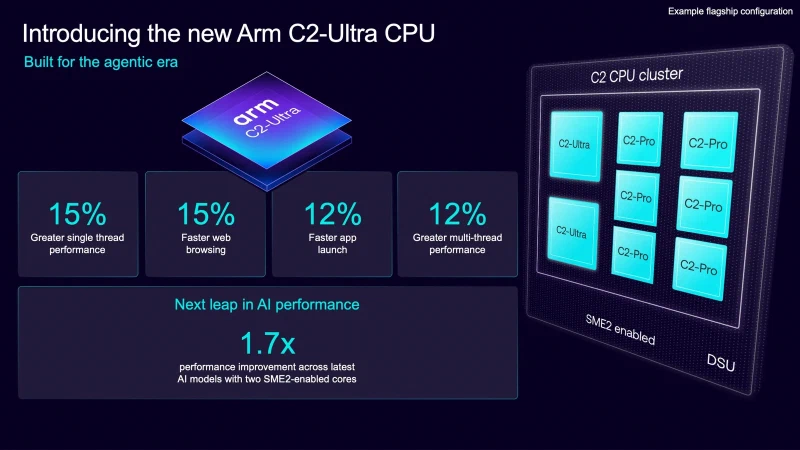
Arm has introduced Arm CSS for Mobile 2, a compute platform for smartphone chips that combines the C2 CPU cluster, the Mali G2-Ultra NX GPU and the SI L2 system interconnect. The C2 cluster pairs C2-Ultra and C2-Pro CPUs with two SME2 units, the Scalable Matrix Extension 2 that speeds up matrix math for AI on the CPU. Arm says this doubles the SME2 capability of the previous-generation configuration and reports up to 1.7x performance across the latest AI models.

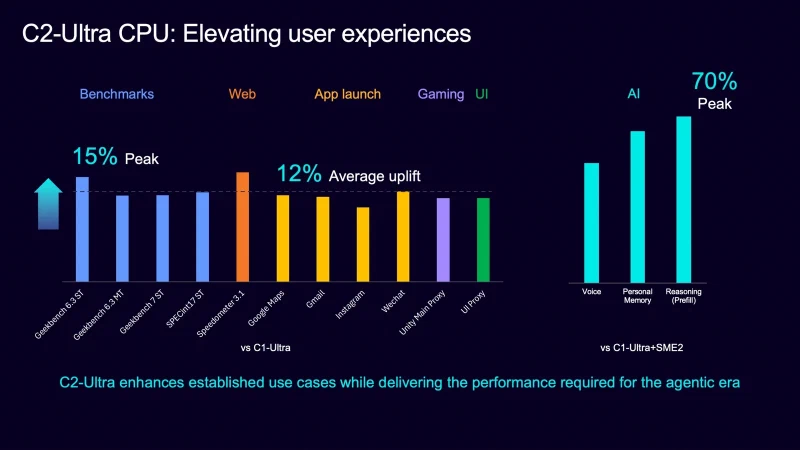
The cluster delivers up to 15% higher single-thread performance, 15% faster web browsing, 12% faster app launch and 12% higher multi-thread performance, Arm reports. For AI, it cites a peak uplift of up to 70% in selected tasks. Its slide compares speech, personal memory retrieval and prefill, the phase where a model reads the prompt, against the C1-Ultra with SME2. In a representative agentic workflow covering speech processing, memory retrieval, reasoning, app execution and web browsing, the C2-Ultra with two SME2 units finishes 24% faster than the previous generation, according to Arm.

Bar chart comparing the C2-Ultra CPU with the C1-Ultra across benchmarks, web, app launch, gaming and UI at 12% average uplift and 15% peak, plus AI tasks with a 70% peak
Arm's own comparison of the C2-Ultra with the C1-Ultra, with the AI tasks measured against the C1-Ultra with SME2 Credit: Arm
The example flagship configuration in Arm’s slides has two C2-Ultra and six C2-Pro cores. The Mali G2-Ultra NX GPU integrates neural accelerators into its shader cores and adds a new execution engine and a third-generation ray tracing unit for neural graphics. Arm says the SI L2 interconnect provides lower-latency access, higher bandwidth, coherency and quality-of-service controls for CPU, GPU and other resources working at the same time. Partners can use each component on its own or combine them with custom and third-party IP.

Slide showing an example C2 CPU cluster with two C2-Ultra and six C2-Pro cores, SME2 enabled, next to 15%, 15%, 12% and 12% gains and a 1.7x AI figure
Arm's slide for the C2-Ultra CPU with an example flagship cluster layout Credit: Arm
On the software side, Arm lists KleidiAI, its optimized libraries for Arm CPUs including SME2 paths, plus integrations with common AI frameworks. The Arm AI Portal offers validated models with performance and accuracy data, code examples and deployment resources, and the Arm MCP Server connects them to agentic development tools. vivo says it is bringing Arm Neural Technology to its latest flagship smartphones built on the platform, aimed at mobile gaming. Arm’s post names no launch dates for devices with CSS for Mobile 2.

Arm unveils Mali G2-Ultra NX GPU with neural accelerators in every shader core

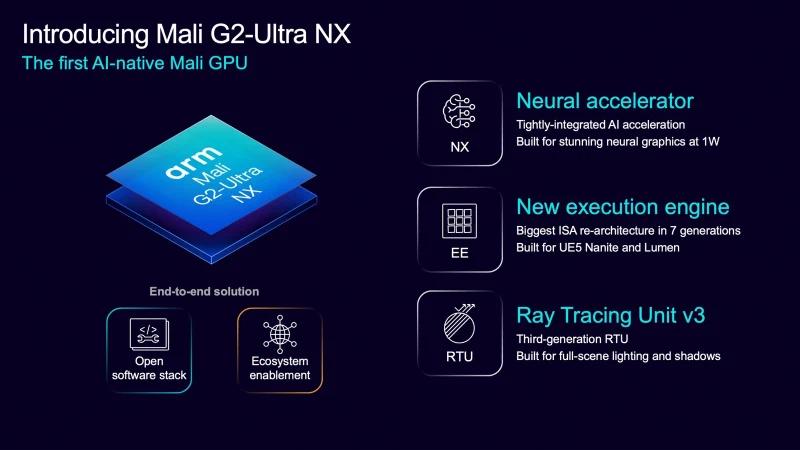
Arm has introduced the Mali G2-Ultra NX, a smartphone GPU that places dedicated neural accelerators inside each shader core. The accelerators reuse the GPU’s memory system, coherent caches and control structures, support INT8 and INT16 processing and include hardware-accelerated optical flow for motion estimation. Arm calls it the first AI-native Mali GPU and positions the accelerators for neural graphics at 1 W. The GPU is part of the Arm CSS for Mobile 2 platform.

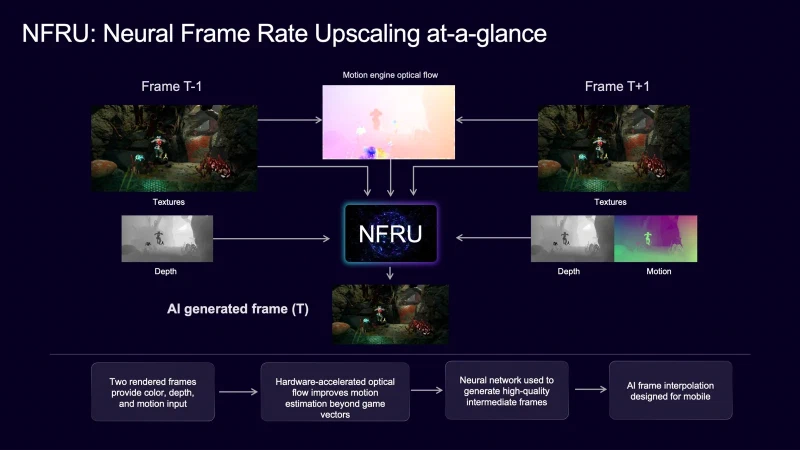
The GPU reaches up to 24% higher benchmark performance than the previous generation and 14% higher performance in non-AI gaming workloads, Arm says. Its neural graphics features are Neural Super Sampling, which reconstructs a higher-resolution image from a lower-resolution render, Neural Frame Rate Upscaling, which generates intermediate frames, and Neural Super Sampling and Denoising, which combines upscaling with denoising for ray-traced scenes. Arm says frame rate upscaling supports up to 120 FPS for longer gaming sessions. In its Neural Dawn demo, Arm reports up to 4x higher performance efficiency and up to 70% lower external memory traffic.

Slide summarizing the Arm Mali G2-Ultra NX GPU and its neural accelerator integrated into the shader core
Arm's overview slide for the Mali G2-Ultra NX Credit: Arm
Diagram of Neural Frame Rate Upscaling generating an intermediate frame from two rendered frames with color, depth, motion and optical flow input
Arm's diagram of how Neural Frame Rate Upscaling builds an intermediate frame Credit: Arm
The new execution engine is the largest update to the Mali instruction set architecture in seven generations, Arm says, with up to 2x more registers per warp. The third-generation hardware ray tracing unit adds support for Opacity Micromaps, which handle complex transparent geometry. Arm reports up to 13% lower DRAM traffic on ray tracing benchmarks, a 30% higher frame rate and up to 70% less ray tracing work in a scene from Moku’s Central Garden.

For developers, Arm offers the Arm Neural Graphics Development Kit with machine learning extensions for Vulkan, plug-ins for Unreal Engine, an SDK for custom engines and tools for profiling, training and model optimization. Arm names integrations with Tencent Games Central Tech’s Magic Dawn engine, Unity China’s Tuanjie Engine and Unreal Engine MegaLights. Keli Zhou, engine lead for Where Winds Meet, says the game will be among the first to bring Arm Neural Technology to players. Arm’s post names no launch dates for devices with the GPU.

MediaTek launches Dimensity 9600 Pro, a 2nm chip for on-device models up to 30B parameters

MediaTek announced the Dimensity 9600 Pro, a flagship smartphone chip built on a 2nm process. According to the company, its NPU 1090 supports on-device applications with models of up to 30B parameters. MediaTek reports 51% higher LLM prefill performance, the phase where the model reads the prompt, and 55% higher token generation per watt, measured on demo devices in its own labs.

The chip pairs the NPU 1090 with a second-generation Super Efficient NPU, which MediaTek says cuts power consumption for always-on AI by 40%. The platform supports LPDDR6 memory and UFS 5.0 storage.

In September 2025, MediaTek announced that it had completed the tape-out, the final design handoff to the fab, of a flagship chip on TSMC’s N2P 2nm process, with volume production expected in late 2026. The CPU uses a 2+3+3 layout of eight big cores, with two C2-Ultra cores at up to 4.55 GHz. MediaTek states up to 17% higher single-core and up to 15% higher multi-core performance over the previous generation, and up to 61% lower multi-core power consumption.

The first smartphones with the Dimensity 9600 Pro and the related Dimensity 9600M are expected to launch this quarter, according to MediaTek.

Thursday 17 September 2026

Cactus releases Needle 3, a 121M-parameter tool-calling model in an 8 to 29 MB binary

Cactus has released Needle 3, a model with 121 million parameters for tool calling, structured extraction and text embedding. The whole model ships as a single binary of 8 to 29 MB, and Cactus says it beats models ten times its size on mobile tool calls and matches models two to three times larger on extraction. The README names mobile devices, wearables, robots, smart home, automotive and microcontrollers as targets.

Needle 3 uses a Laddered Simple Attention Network, trained so that every depth from 2 to 20 layers yields a deployable model. Most of its parameters sit in an n-gram memory the README calls the engram, so the 121M model does the arithmetic of a 50M one. Weights are stored at 2.125 bits per weight in Cactus’s own quantisation format. A grammar compiled from the user’s schema constrains the output, and every response carries a calibrated confidence score next to the function calls and the model’s reasoning.

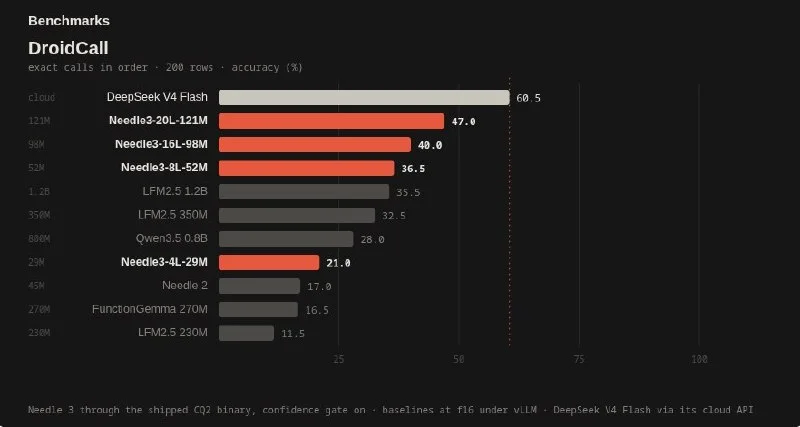
The 20-layer, 121M variant scores 86.0% exact-call accuracy on Mobile Actions in the chart Cactus published with the README. That is ahead of LFM2.5 1.2B at 82.4%, Qwen3.5 0.8B at 76.0% and Needle 2 at 63.5%, while DeepSeek V4 Flash reaches 88.4%. On DroidCall the same variant scores 47.0% against 35.5% for LFM2.5 1.2B, and on BFCL v4 it scores 50.2% against 62.0% for LFM2.5 1.2B. The 8-layer, 52M variant reaches 36.8% on Mobile Actions and the 4-layer, 29M variant 11.7%.

Needle 3 benchmarks on DroidCall

Fine-tuning on the DroidCall dataset lifts every subnetwork by 18 to 36 points, according to the README, and tuned subnetworks from 4 layers upward exceed DeepSeek V4 Flash. Fine-tuning and export run locally at 4-bit with the needle finetune and needle build commands. Cactus offers advanced 2-bit post-training through its own platform.

Developers install the Python package with pip install cactus-needle and declare tools as decorated functions. Each deployment target gets a prebuilt engine under 1 MB that loads the model file at startup, with builds for macOS ARM64, Linux ARM64, the browser and WASI. The weights are on Hugging Face under Apache 2.0, according to the model card, and a browser demo is on the Cactus website. Telemetry is on by default and can be switched off with the NEEDLE_TELEMETRY=0 and DO_NOT_TRACK=1 environment variables.

Prism ML releases Bonsai 2 27B for iPhone, iPad and Mac, with a 3.9 GB 1-bit version

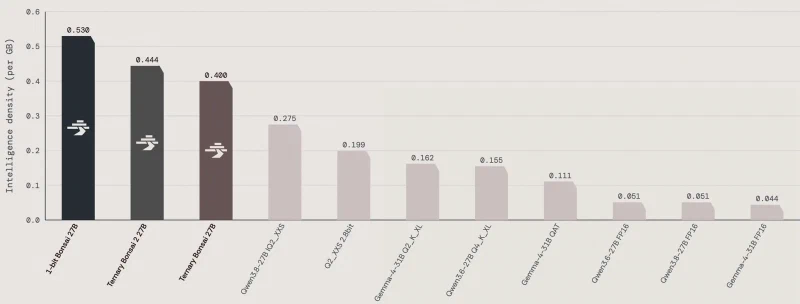
Prism ML has released Bonsai 2 27B, a compressed version of Qwen3.8 27B that runs on Apple devices including iPhone, iPad and Mac via MLX, using custom low-bit kernels. On NVIDIA GPUs it runs via CUDA. For the iPhone 17 Pro, Prism lists a 1-bit version at 3.9 GB with a 262K-token context window.

The main Ternary Bonsai 2 27B model stores each weight as -1, 0 or +1 with FP16 scaling per group of weights. This works out to 1.76 effective bits per weight and a total footprint of 5.9 GB, which Prism says is more than 9x smaller than the full-precision model. The model accepts text and image input.

Prism reports an aggregate benchmark score of 83.9 for the ternary model, compared with 85.4 for Qwen3.8 27B, which it describes as 98.2% retention. The model scores 82.66 in instruction following against 81.25 for the original, and trails it in knowledge and reasoning (83.95 against 86.66), vision (78.59 against 81.64) and agentic tool calling (77.57 against 79.74). Prism also gives 96.57 for math and 81.58 for coding, against 97.06 and 82.17 for Qwen3.8 27B.

According to Prism, the ternary model generates up to 143 tok/s on an NVIDIA GeForce RTX 5090 and 46.8 tok/s on an Apple M5 Max. On an RTX 4090 it uses 0.714 mWh per token, which the company says is 40% less than a full-precision 8B model. The project repository lists peak memory for text-only use at about 7.8 GB at 4K context and 13.7 GB at 100K context, with images adding about 0.9 GB.

The model is released under the Apache 2.0 license. The Hugging Face collection holds GGUF and MLX 2-bit versions, and the repository documents running it with llama.cpp on Macs with Apple silicon and on CUDA, Vulkan, ROCm and CPU. A WebGPU demo runs in the browser on Hugging Face Spaces.

Wednesday 16 September 2026

ASUS announces Ascent QN10, a mini PC with Snapdragon X2 Elite and an 80 TOPS NPU

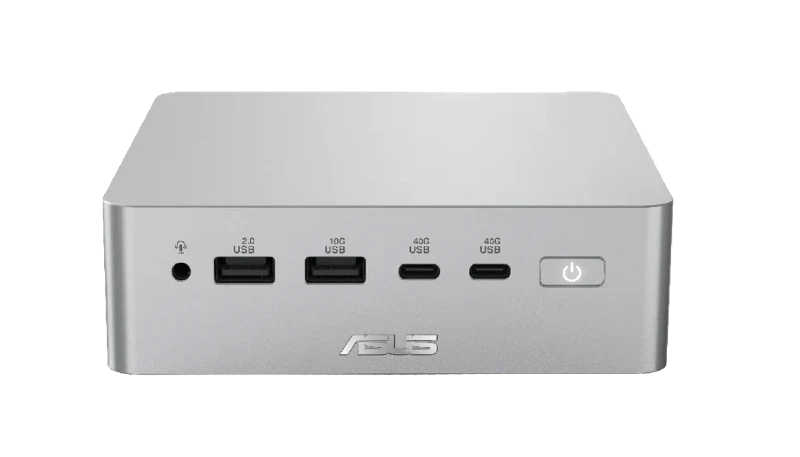
ASUS has announced the Ascent QN10, a mini PC built on the Snapdragon X2 Elite platform with an 18-core Qualcomm Oryon CPU and a Hexagon NPU rated at up to 80 TOPS. The company calls it the first AI mini PC with an 80 TOPS NPU and says it exceeds the Copilot+ PC requirements. The chassis measures under 0.7 liters, which ASUS puts at 86% smaller than a conventional 5-liter desktop, and the Adreno GPU is 2.3 times faster than in the previous generation.

According to ASUS, the NPU is meant for local LLM inferencing, real-time translation, content generation, video enhancement and AI assistants. Developers can reach the Qualcomm AI Hub, which offers 175+ pre-optimized models and supports bringing their own models and data. The PC also runs agent frameworks such as OpenClaw and Hermes Agent, and ASUS describes a hybrid setup that routes workloads between cloud LLM APIs and the local NPU.

Guru3d lists 16 GB or 32 GB of soldered LPDDR5X, two M.2 slots, Windows 11 on Arm and a 130 x 130 x 40 mm body, and reports that no price has been announced. The Gadgeteer names $1,349 for 16 GB with 512 GB of storage and $1,699 for 32 GB. Connectivity includes WiFi 7 and Bluetooth 6.0, and security comes from fTPM 2.0 and the Microsoft Pluton processor.

Thursday 10 September 2026

Edge0 releases MoE expert-offloading framework, demos 35B model on iPhone

Samuel Zeng has released Edge0, an open-source framework for streaming mixture-of-experts inference, under Apache-2.0. In his launch post he reports a 35-billion-parameter model running on an iPhone at 1 to 2.5 GB of peak memory without a cloud connection.

The repository describes three techniques. Expert weights are streamed from storage on demand, so peak memory is bounded by the active set. A trained prerouter predicts expert routing one step ahead so that loads overlap the forward pass, which the project credits with up to 59 percent higher throughput. Recover-LoRA pairs an int4-quantised frozen base with distilled LoRA adapters.

Two tiers are published. edge0-35b has 40 layers and 256 experts, a checkpoint of roughly 23 GB and about 2.9 GiB of peak active memory. edge0-8b has 24 layers and 128 experts, a 4.2 GB checkpoint and about 1.0 GB peak. On a Mac mini M4 Pro with 24 GB, the project measures 14.9 to 17.7 tokens per second of decode for the 35B tier and 23.9 to 25.3 for the 8B tier, with prefill at 113 tokens per second cold and 140 warm for 35B. Quality loss against FP16 baselines is given as 3.9 points on average for the 35B tier and 2.8 points for the 8B tier.

The repository states that the MLX backend runs on macOS with Apple Silicon, on M1 through M4, and requires Python 3.10 or newer.

Demo by Samuel Zeng. Watch original on X

llama.cpp Hexagon NPU backend tested on a Snapdragon 8 Gen 3 phone

A user has reported results from llama.cpp’s Hexagon NPU backend on a OnePlus 12 with a Snapdragon 8 Gen 3. They cross-compiled llama.cpp on Ubuntu following the project’s Snapdragon documentation and ran it from Termux on the phone.

The reported figures are 8 tokens per second of prompt processing and 4.5 of generation with gemma-3-12b-it-qat at Q4_0, and 20 tokens per second of prompt processing and 12.5 of generation with gemma-3-4b-it-qat at Q4_0. According to the report the speed is about the same as running on the same chip’s CPU, but the phone does not get hot.

The report lists several limitations. The backend accepts only Q4_0, IQ4_NL, MXFP4, Q8_0 and F32 files, and does not support KV cache quantisation. It runs on chips as old as the Snapdragon 888, but the poster notes that only the 8 Gen 2 and newer carry the tensor module used for language models. The Hexagon NPU can address 4 GB, so a model plus KV cache beyond that has to be split across more than one NPU device:

LD_LIBRARY_PATH=./lib:/vendor/lib64 \
  ADSP_LIBRARY_PATH=./lib \
  GGML_HEXAGON_NDEV=2 \
  ./bin/llama-completion \
  -m /sdcard/gguf/gemma-3-12b-it-qat-Q4_0.gguf \
  -ngl 99 --device HTP0,HTP1 \
  -sys 'You are a helpful AI assistant'

For context the poster cites 34 INT8 TOPS and 76.8 GB/s of memory bandwidth for the 8 Gen 3 NPU, against 80 TOPS and 228 GB/s for Qualcomm’s X2 Elite Extreme and 248 TOPS and 936 GB/s for an Nvidia RTX 3090. They ask readers with a Snapdragon 8 Elite Gen 5 phone or an X2 Elite Extreme laptop to post their own numbers, since those parts are said to address more than 4 GB and would not need multiple devices.