All updates

News and context on AI running on mobile devices.

Tuesday 13 October 2026

Liquid AI releases LFM2.5-24B-A2B, a 2B-active MoE for local agents
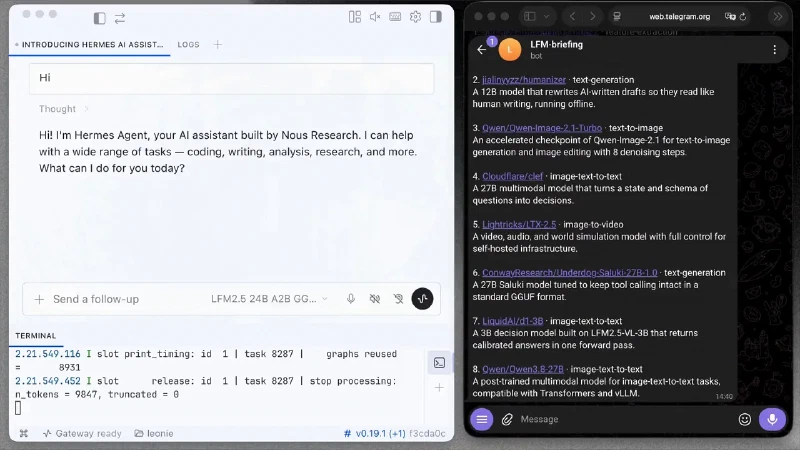
Liquid AI has released LFM2.5-24B-A2B, a mixture-of-experts model with 24 billion parameters of which 2.45 billion are active per token. In MoE models only part of the network runs for each token, which keeps compute low while the weights stay large. The company measured 184 tokens per second on an Apple M5 Max and 114 tokens per second on an AMD Ryzen AI Max+ 395, and says the model decodes up to 1.7 times faster than comparable MoE models on-device.

The context window grew from 32,768 tokens in the earlier LFM2-24B-A2B to 131,072 tokens, and the vocabulary doubled from 65K to 128K. Liquid AI scaled pre-training from 17 trillion to 33 trillion tokens. The architecture combines gated short convolutions with grouped-query attention across 40 layers and routes each token to 4 of 64 experts per MoE block. The new version is reasoning-only, so it always emits an explicit chain of reasoning before its answer.

Liquid AI counts the model as leading or matching Qwen3.6-35B-A3B on five of the eight tool-use and agentic benchmarks it ran, and reports more than three times the competitor’s score on AutomationBench at 27.69 against 8.72. Qwen stays ahead on knowledge in GPQA Diamond and on coding in SWE-Bench Verified through OpenCode. The model card advises against knowledge-heavy tasks on their own and recommends pairing the model with retrieval or web search, which it says plays to its tool-calling strength.

LFM2.5-24B-A2B benchmark scores

BenchmarkLFM2.5-24B-A2BQwen3.6-35B-A3B
AutomationBench27.698.72
LiveClaw48.0938.19
ToolSandbox80.71
IFEval96.75
GPQA Diamond74.4283.69
SWE-Bench Verified (OpenCode)51.0066.20

All figures according to Liquid AI. The comparison model is Qwen3.6-35B-A3B.

A demo video shows the model running inside Hermes Agent on an M5 Max MacBook Pro, planning tool calls and assembling a briefing from trending Hugging Face models without any cloud API call. Liquid AI names OpenClaw, Pi and OpenCode as further agent harnesses it trained and tested the model in. During reinforcement learning the model also learned to look up final answers in a repository’s git history or on GitHub, PyPI and Hugging Face, and according to the company it worked out that it was running in a sandbox.

Open video

Weights are on Hugging Face under the LFM License, with FP8, ONNX and MLX 4-bit variants alongside GGUF builds that run from 13.6 GB at Q4_0, a checkpoint Liquid AI trained with quantization-aware distillation. Supported runtimes include llama.cpp, MLX, vLLM, SGLang and ONNX, and the model covers 16 languages including English, German, Chinese, Japanese and Hindi. Through Liquid AI’s own API it costs $0.10 per million input tokens, $0.05 for cached input, and $1.00 per million output tokens.
Thursday 8 October 2026

Qualcomm CEO says AI companies want 100B-parameter models running on phones by 2028

Qualcomm chief executive Cristiano Amon says AI companies have asked his company to make phones capable of running at least a 100-billion-parameter model by 2028, with the model active almost continuously. Amon made the remarks on Alex Heath’s Sources podcast, recorded live at Qualcomm’s Snapdragon Summit in Maui, though he declined to name the companies behind the request. He said they want a model “running kind of all the time”, according to a transcription by The Next Web.

Some of the companies at the forefront of AI are telling Qualcomm, ‘By 2028, I need to make sure that I have the ability to run at least a hundred billion parameter model into a phone.’

AI companies are also starting to build their own handsets, Amon said, naming ByteDance’s Doubao phone, manufactured by Nubia, as an example from China and adding that more are coming. Heath pointed out that personal agents such as Muse and Grok Bot drive browsers on virtual machines in the cloud rather than on the phone. Amon answered that some of that work will stay in data centers while some of it has to happen on the device.

Humans are not going to go travel to a data center, ring the bell and say, ‘Give me some AI.’

Amon likened the moment to the early iPhone, when the applications that later defined the platform did not yet exist. He said “The smartphone was defined by the third-party applications,” and he expects agents to play that role on the next generation of phones. The launch of OpenClaw made the idea of an AI-first smartphone concrete for him, he said, describing an agent that plans, routes tasks and acts on the user’s behalf.

Qualcomm’s current flagship silicon sits below that 2028 target. The company announced the Snapdragon 8 Elite Extreme Gen 6 at the same summit, and Computerbase reports that the Extreme variant gets 50 percent more dedicated NPU memory, which Qualcomm says prepares it for mixture-of-experts models, where only part of the model is active per token — the example given is a 30-billion-parameter model with roughly 3 billion active. The interview does not say how much memory or storage a 100-billion-parameter model would need on a phone.

Memory prices have risen five to six times, Amon said, and the smartphone market is down 20% this year as a result. He said buyers are putting off upgrades rather than losing interest, saying “It’s not a demand problem” and pointing to pent-up demand. Amon put annual phone sales at about 1.2 billion units and said the market remains smaller than it was in 2019.

Saturday 26 September 2026

FunctionGemma 270M fine-tune reaches 76.5% on 15 mobile actions, with an Android demo

Google’s FunctionGemma 270M-it reaches 76.5% end-to-end accuracy on mobile device commands once it is fine-tuned on a synthetic dataset, up from 29.3% for the base model on the same held-out evaluation set. The paper behind the fine-tune introduces MobileActionsExtended, a set of about 9,500 records covering 15 device-control categories. UGrowAI released the weights, the datasets, the training code and a working Android app alongside it.

The 15 categories cover toggling lights, sending email and SMS, placing calls, reading battery and Bluetooth status, taking pictures and screenshots, adjusting screen brightness, and listing or opening applications. About one third of the prompts require more than one call. A second model trained jointly on the new data and Google’s own mobile actions dataset holds that extended score and reaches 82.3% on Google’s benchmark, which the authors describe as an 8 percentage point trade-off in return for doubling category coverage. The figures come from greedy decoding with no schema-constrained decoding, so the model has to emit a valid call on its own rather than being forced into the right format.

FunctionGemma 270M end-to-end accuracy on mobile function calling

BenchmarkFunctionGemma 270M (fine-tuned)Base FunctionGemma 270M
MobileActionsExtended76.4829.33
MobileActionsGoogle60.1558.79
MobileActionsExtended (combined model)76.4829.33
MobileActionsGoogle (combined model)82.3158.79

Strict exact-match end-to-end accuracy in percent on the two held-out evaluation sets, all figures according to UGrowAI and measured on unquantized checkpoints. Google's own Mobile Actions specialist scores 90.32 on MobileActionsGoogle and 17.20 on MobileActionsExtended.

The demo app, Handy Chat, runs the model on a Google Pixel 8 Pro through the LiteRT-LM CPU backend rather than the GPU, with an exported bundle of 285.6 MB. The training data is synthetic rather than collected from real users, and the dataset and the demo cover only English and Android. Both fine-tuned models and both datasets are on Hugging Face under the UGrowAI account, with GitHub repositories for the fine-tuning pipeline and a downloadable APK.

Google adds local model support to the Antigravity SDK with Gemma 4 on LiteRT

Google has given the Antigravity SDK the ability to drive agents with models running on the developer’s own machine, so a full agentic loop can execute without an API call. The featured configuration runs Gemma 4 26B A4B through LiteRT, and Sachin Kotwani and Taylor Mullen recommend a machine with more than 24 GB of VRAM or unified memory. Google names cost, privacy and offline resiliency as the reasons to keep the loop local.

Two configuration classes carry the feature. LiteRTAgentConfig points the agent at a local LiteRT model file, while LocalOpenAIAgentConfig connects to any OpenAI-compatible server, with Ollama, LM Studio and vLLM named as examples. The SDK repository installs both with pip install google-antigravity litert-lm, states that the setup works best with gemma-4-26B-A4B-it-gpu.litertlm, and suggests a 64K context size. That checkpoint is a mixture-of-experts model, where only part of the weights is active per token, with 26 billion parameters in total and roughly 4 billion active, and it ships at about 15.8 GB as a quantisation-aware trained int4 build with float activations.

A hybrid arrangement Google calls the Architect-Builder pattern splits the work between cloud and device. Gemini 3.8 Flash plans in the cloud and hands the steps to a local swarm of Gemma 4 26B instances, which Google demonstrates on a task that audits and patches three vulnerable Python modules. The run consumed 95 cloud tokens against 3,322 local ones, putting 97.2% of the tokens on the machine, with only filenames leaving it.

Google's recording of the Architect-Builder run, with Gemini 3.8 Flash planning and local Gemma 4 instances patching the code. Open video

Throughput depends heavily on the hardware. The LiteRT community model card reports 4,487 prefill and 86 decode tokens per second on an Nvidia RTX 4090 under Linux, 1,430 prefill and 77 decode on an M4 Max, and 1,676 prefill and 76 decode on an RTX 5080 under Windows, with the macOS run taking about 16.2 GB of GPU memory. The model is published under Apache 2.0, and a second example in the announcement has the local agent write a terminal dashboard with the psutil and rich libraries that tracks CPU load, memory use and the five most memory-hungry processes.

Nvidia releases Nemotron-3-Diarization, a 100M speaker model with 0.32 second latency

Nvidia has released Nemotron-3-Diarization, an open-weights model with 100 million parameters that works out who speaks when in a recording, for up to eight speakers, in either streaming or offline mode. Streaming runs at an input-buffer latency of as little as 0.32 seconds, and the license is the OpenMDW License Agreement v1.1, which Nvidia states covers commercial and non-commercial use.

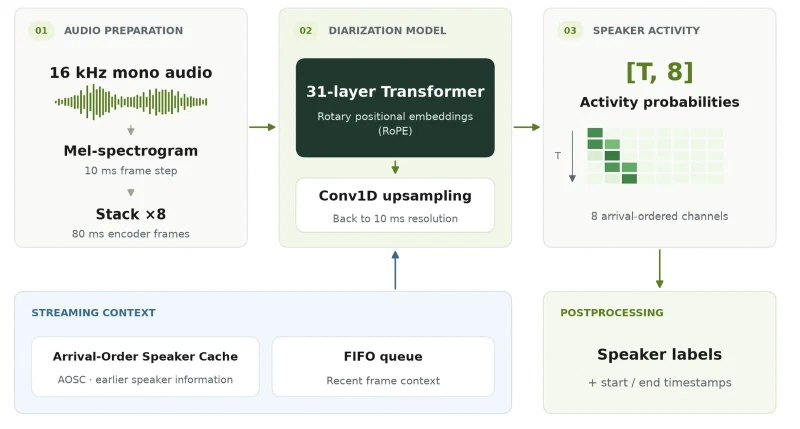
The model takes single-channel 16 kHz audio in WAV, FLAC, OPUS or MP3, turns it into a mel-spectrogram and runs it through a 31-layer transformer encoder with rotary positional embeddings, returning per-speaker activity probabilities at 10 ms resolution in a tensor of shape [T, 8]. Streaming works through the Sortformer design, which pairs an Arrival-Order Speaker Cache holding the identities of speakers heard earlier in the conversation with a FIFO queue of recent frames. Four presets trade delay against accuracy, running from 30.4 seconds for offline processing down through 1.04 and 0.64 seconds to the 0.32-second minimum Nvidia recommends.

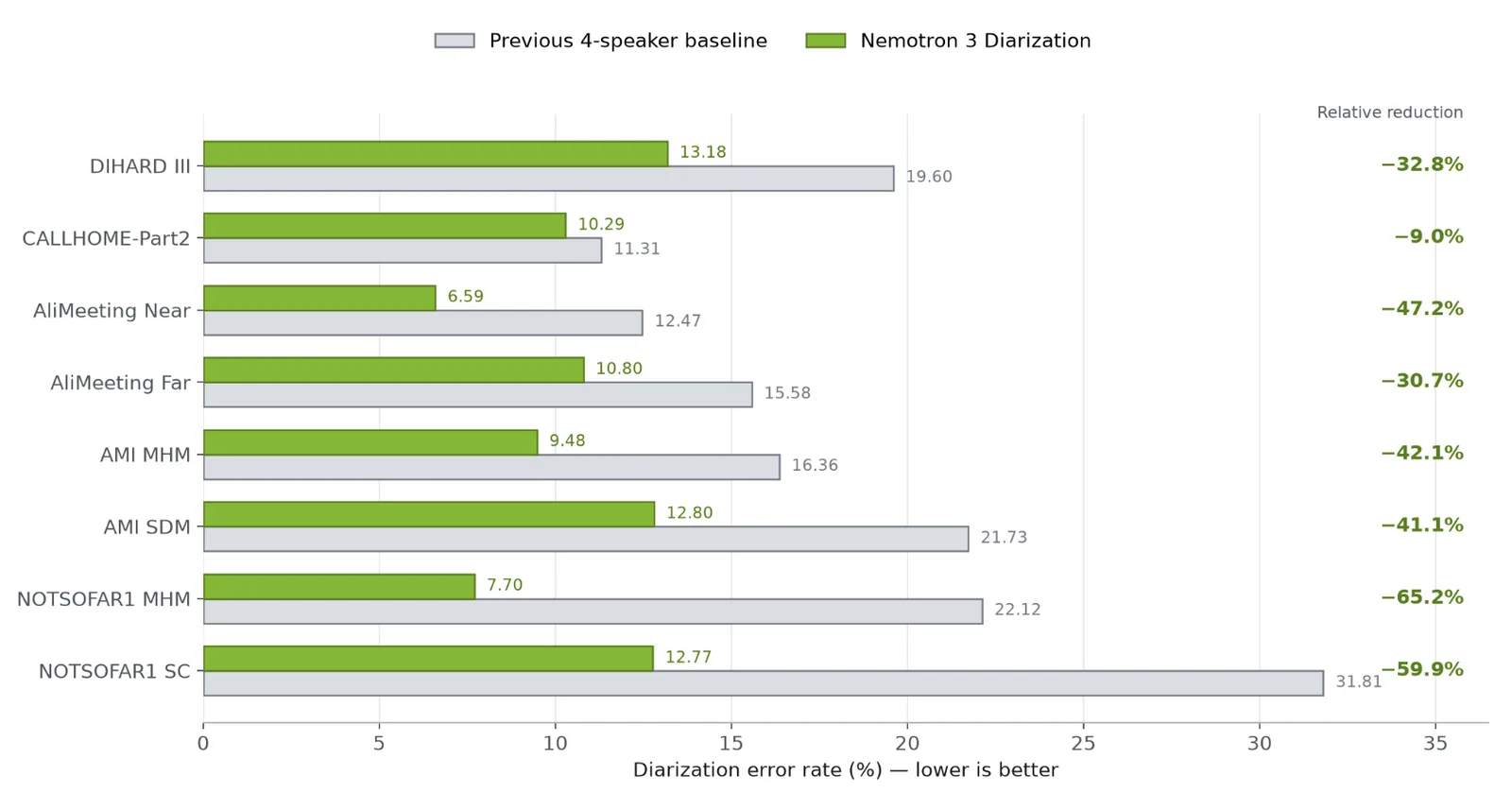
Voice Arena Research put the model first among 12 diarization systems on its Diarization-Bench v1 leaderboard, scoring 14.7% diarization error rate at a 0 ms collar across 139 conversations and 22 hours of English audio, about 4.6 points ahead of second-placed DiariZen. Diarization error rate combines missed speech, false alarms and speaker confusion into one figure, so lower is better. Nvidia’s own measurements at the 1.04-second setting give 13.18% on DIHARD III and 7.70% on NOTSOFAR1 MHM, against 19.60% and 22.12% for the four-speaker Streaming Sortformer v2.1 it replaces.

Bar chart comparing diarization error rates on eight datasets, with Nemotron 3 Diarization lower than the previous four-speaker baseline on every one, by between 9 and 65 percent

Nvidia’s own error rates at the 1.04-second latency setting, measured against its previous four-speaker model.Nvidia

Local inference runs through NeMo-Speech.cpp, a native C++ runtime with CPU, Metal and Vulkan backends that loads Nvidia speech checkpoints converted to GGUF and lists this model among the ones it supports. Argmax has put the model into Pro SDK 3, its on-device speech kit for Mac and iPhone, which can be tried through the Argmax Playground app on TestFlight. The company compared six diarization systems for the release.

Nemotron 3 Diarization achieved the lowest error rate (DER) across all 6 systems.

Alongside the C++ runtime, the checkpoint loads in the NeMo framework and in Hugging Face Transformers through AutoModelForAudioFrameClassification, and a browser demo is on Hugging Face. The PyTorch path needs an Nvidia Ampere, Ada Lovelace, Hopper or Blackwell GPU on Linux at BF16 precision, where Nvidia reports a real-time factor of 15,113 at the offline setting and 865 at 1.04 seconds on an RTX PRO 5000 at batch size 32. Nvidia names recordings with more than eight speakers, far-field microphones, noise and reverberation as conditions that raise the error rate.

Perplexity brings its local Portable Computer agent to AMD Ryzen AI Max PCs

Perplexity has brought Portable Computer, the on-device version of its Computer agent platform, to Windows PCs running AMD Ryzen AI Max Series processors, including the Ryzen AI Halo developer platform. Systems need at least 24 GB of GPU-accessible memory to run it, and the feature is available to Pro and Max subscribers through the Perplexity Windows app.

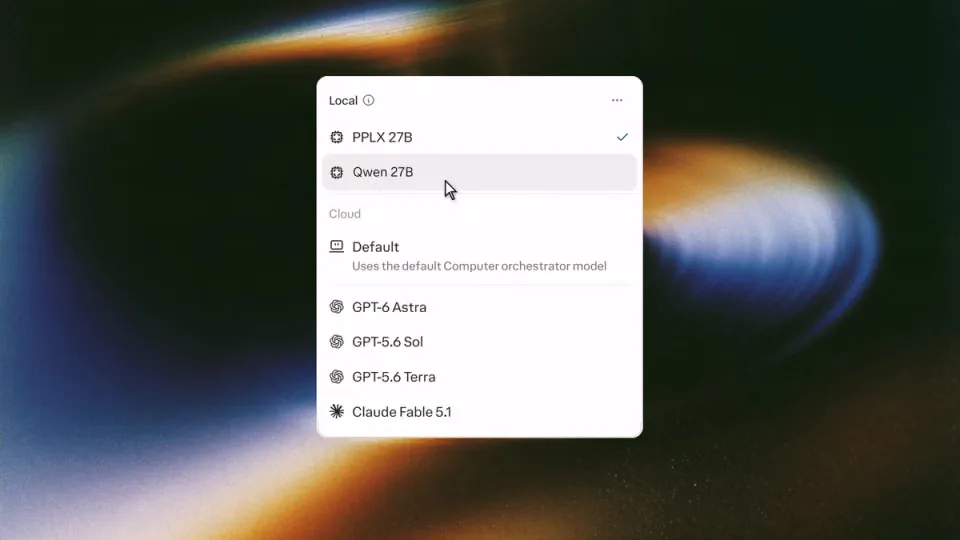
The package bundles the local model, the agent orchestrator, a scheduler, a sandbox and a sensitive-content classifier into one system instead of leaving users to assemble the parts themselves. Two local models are offered, Qwen 3.8 27B and Perplexity’s post-trained PPLX 27B, which the app downloads with one click from its Local Inference settings. AMD says its Ryzen AI Max processors combine CPU and GPU with a large pool of shared memory so local models can run alongside everyday applications.

Perplexity model picker with a Local section listing PPLX 27B and Qwen 27B, above a Cloud section with Default, GPT-6 Astra, GPT-5.6 Sol, GPT-5.6 Terra and Claude Fable 5.1

Portable Computer puts the two on-device models into the same picker the app uses for its cloud models.Perplexity

Tasks run either as one-off requests or on a recurring schedule across local files and connected services such as Gmail, Outlook, Slack and GitHub, while local Model Context Protocol servers, a standard for connecting tools to models, reach other installed applications. Perplexity names financial reconciliation, daily briefings, contract review and pull request summaries as examples. Local inference does not consume Perplexity Computer credits, and escalating a task to a cloud model for current information or harder reasoning requires the user’s permission.

Code runs inside an isolated sandbox whose file access is limited to folders the user approves, and an on-device classifier flags sensitive content before anything leaves the machine. Beyond the memory requirement, Portable Computer needs Windows 10 or Windows 11 and about 20 GB of free disk space. The agent first shipped on Linux and Nvidia’s DGX Spark before reaching Windows PCs with GeForce RTX and RTX PRO cards holding at least 24 GB of VRAM. Neither company published token throughput or task completion figures for Ryzen AI Max systems.

Friday 25 September 2026

Liquid AI releases a DSpark drafter that speeds up LFM2.5-VL-3B decoding

Liquid AI has released an experimental DSpark draft model for LFM2.5-VL-3B, its 3-billion-parameter vision-language model. The drafter adds 279.5M parameters, an 8.9% increase over the deployed model. In exchange, the company reports decoding throughput gains of up to 3.13x on edge devices and up to 2.66x on GPUs, with end-to-end gains of up to 2.62x and 2.27x.

On an Apple M5 Max MacBook Pro running MLX-VLM, decoding ran 2.30x to 3.13x faster across six vision tasks, with end-to-end latency improving 1.56x to 2.62x. The same tasks on an M3 Ultra with llama.cpp gave 1.57x to 2.14x faster decoding and 1.30x to 1.77x end to end, while an NVIDIA H100 80GB with SGLang reached 2.04x to 2.66x. Liquid AI measured all of it at batch size 1 and reports that the drafter’s guesses were accepted at a rate of 3.2 to 4.57 tokens per verification pass.

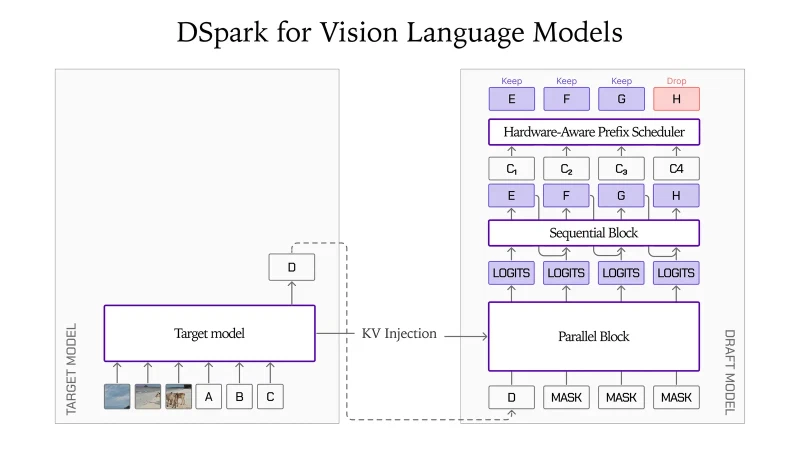
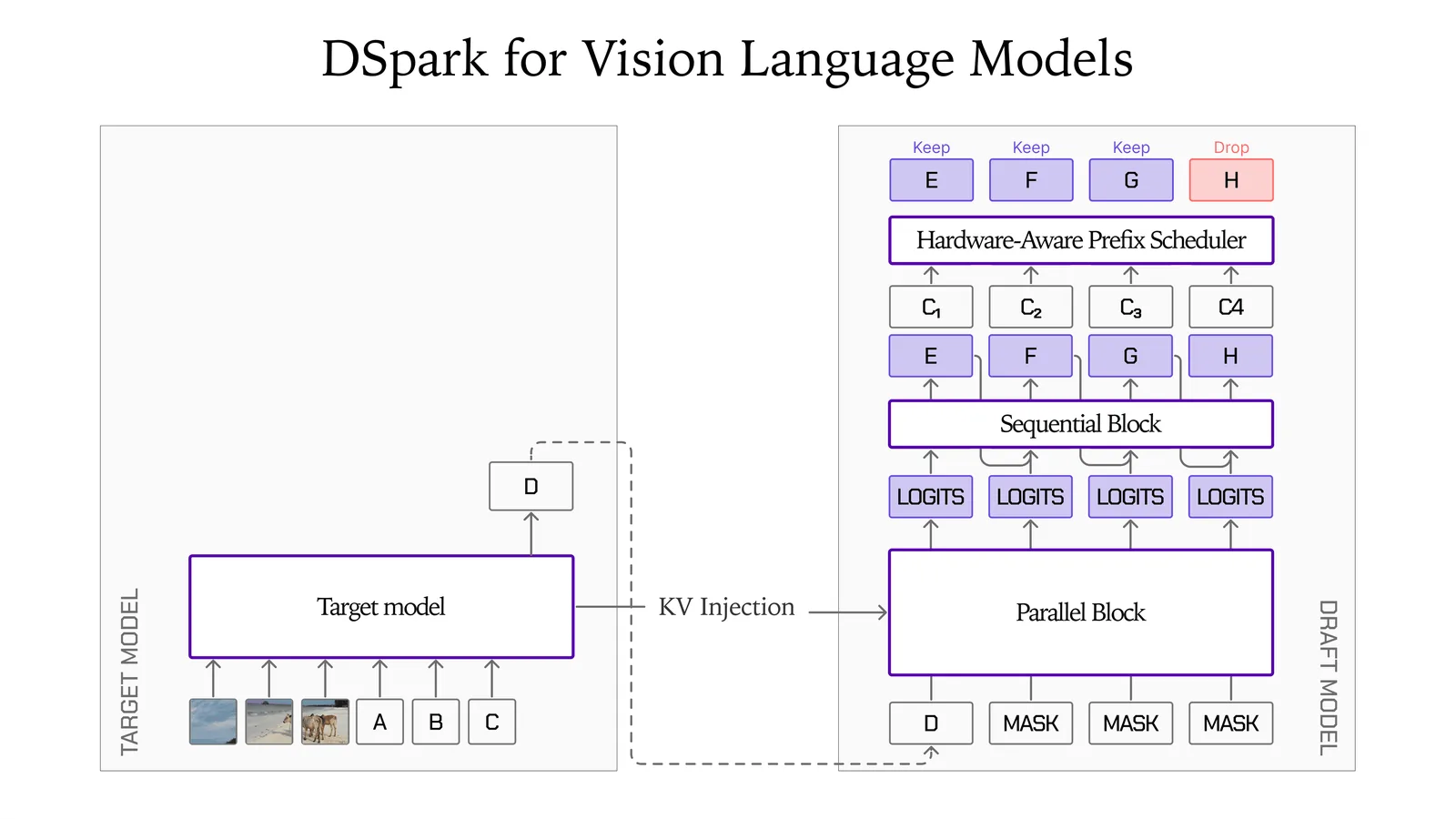
Speculative decoding lets a small model guess the next few tokens, which the full model then checks in a single pass and accepts or rejects, so the output does not change. DSpark takes hidden states from different layers of the target model and feeds them to the drafter, a 4-layer decoder stack of 193.0M parameters combined with a 65.5M-parameter Markov head, a hidden-state projection and a confidence head. The design carries over from text to vision without modification, Liquid AI says, because image patches and text are both multi-dimensional tensors by the time they reach the hidden layers, which makes the input modality irrelevant to the drafter.

Diagram showing a target model processing image patches and text tokens, with KV injection feeding a draft model that speculates four tokens, three kept and one dropped

The drafter receives the target model’s key-value cache and proposes a block of tokens that a hardware-aware prefix scheduler then keeps or drops.Liquid AI

Gains on edge hardware stay below the raw decoding figures for a reason the company names itself. Vision encoding and prefill account for a larger share of end-to-end latency there, and speculative decoding only accelerates the decode phase. Acceleration of quantized models falls outside the scope of this release, and acceptance rates drop at higher temperatures, because probability mass spreads to lower-ranked candidate tokens where drafter and target are more likely to disagree.

The weights are on Hugging Face in Safetensors and as a separate GGUF checkpoint, under Liquid AI’s LFM1.0 license, which the company describes as open-weight and free to download, fine-tune and deploy. Support ships with the release through pull requests to llama.cpp, SGLang and MLX-VLM, and the model card asks for SGLang 0.5.19 or newer on NVIDIA GPUs and MLX-VLM 0.7.2 or newer on Apple silicon. The drafter works only with the LFM2.5-VL-3B target model, at a recommended block size of 9 on NVIDIA hardware and 8 on Apple silicon.

Thursday 24 September 2026

Qualcomm positions Snapdragon X2 as an agentic PC chip and previews Linux support

At Snapdragon Summit 2026 in Maui, Qualcomm framed the Snapdragon X2 Elite and X2 Elite Extreme, the laptop chips it launched a year earlier and has shipped since spring 2026, as the hardware for “agentic” PCs that run AI agents locally rather than answering single prompts. Qualcomm says updated configurations of the Hexagon NPU now reach up to 85 TOPS, up from the 80 TOPS specified at launch, on a platform with 228 GB/s of memory bandwidth. The company also claims up to twice the tokens per second of the first-generation Snapdragon X Elite, 450 supported on-device models, and models up to 30 billion parameters running locally with a 200,000-token context window.

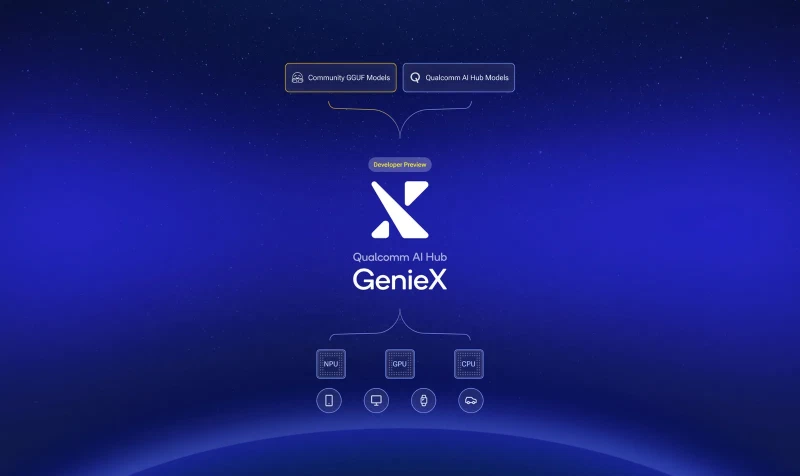
Much of that agent support runs through GenieX, an open-source, BSD-3-Clause inference runtime Qualcomm released in developer preview after acquiring Nexa AI earlier in 2026. GenieX accepts GGUF models from Hugging Face through llama.cpp, precompiled bundles from Qualcomm AI Hub, or a developer’s own model, and dispatches them across the Hexagon NPU, Adreno GPU or CPU. Developers reach it through a local server, a CLI, a Python SDK, Docker or Linux builds, or an Android interface. Qualcomm says AnythingLLM and LLMWare already run natively on Snapdragon X2, while OpenClaw runs directly on top of GenieX.

In its compute keynote at the summit, Qualcomm said its Concierge demo uses this dispatch model for tiered routing: Clairvoyance AI sends chat and simple requests to a 3B model, light tool use to a 9B model, and high-compute agentic work to a 27B model, all served locally on the Hexagon NPU through GenieX. These figures come from the keynote presentation rather than a published spec sheet, and Qualcomm did not disclose which 27B model it used, its quantization, the RAM configuration, context length, tokens per second or sustained thermals for that demo, so the on-device feasibility of the largest tier remains unverified.

One demo Qualcomm calls Creator pairs AnythingLLM with ON1 Photo RAW to search, organize and generate from a photo library using plain-language requests instead of manual tagging or folders. Qualcomm showed two further local-agent demos built with partners: a podcast assistant that uses Deepgram for real-time transcription, and a security agent built with Pokee and Halo for continuous monitoring and deepfake detection.

Running large models locally on a laptop currently means choosing between different platform approaches: Apple pairs its GPU with a large pool of unified memory, AMD’s Strix Halo chips do the same, Nvidia’s laptop GPUs run faster but are limited by fixed VRAM, and Qualcomm’s Snapdragon X2 leans on NPU-driven inference backed by its platform’s 228 GB/s of memory bandwidth rather than a larger GPU.

Qualcomm also published an early developer preview of Linux for Snapdragon X2 laptops, making Linux a third operating system option alongside Windows and Google’s Googlebook platform. The preview boots over UEFI, supports USB and PCIe, and drives the display and GPU through the open-source Freedreno, Turnip and Rusticl stack, while the Hexagon NPU is reachable through the FastRPC driver, running on a Debian 13 userspace with a custom-built kernel that developers have to compile themselves. Qualcomm targets foundational Debian support by the end of 2026, with Ubuntu certification and Linux laptops from HP, ASUS and HUMAIN planned for the first half of 2027. GenieX and the Linux preview are both available to developers now, though neither is consumer-ready, Microsoft’s Windows 11 26H1 update will be exclusive to Snapdragon X2 PCs, and the chips themselves have been shipping in laptops since spring 2026.

Wednesday 23 September 2026

Hugging Face adds native GGUF inference to Transformers, starting with Qwen3.5 on Macs

Hugging Face added native support in Transformers for GGUF, the quantized file format used by llama.cpp, so developers can load those checkpoints through the library’s standard from_pretrained() API instead of switching to a separate runtime. Engineers Marc Sun, Arthur Zucker and Lysandre wrote in the announcement that on Apple Silicon, weights stay packed in their GGUF blocks and Metal GPU kernels run the matmuls directly on the compressed data, skipping a full dequantization step. The feature currently covers Qwen3.5, including its dense and MoE variants, plus compatible Qwen3.8 checkpoints.

The packed inference path draws its Metal kernels from a kernels library that fetches them from the Hub, including ggml-attn, the same flash attention implementation llama.cpp runs for both prefill and decode. Separate kernels handle quantization, normalization and the gated delta net used in the hybrid attention layers of both Qwen3.5 and Qwen3.8. Architectures outside this initial set, or devices other than Apple Silicon, fall back to a legacy loader that dequantizes GGUF weights into a dense model at load time, a path that already covers Llama, Mistral, Qwen2, Qwen2Moe, Phi3, Bloom, Falcon, StableLM, GPT2 and Starcoder2, among others.

On a MacBook Pro M2 Max with 32 GB of memory, Hugging Face reports about 70 tok/s generating with Qwen3.5-4B at Q4_K_M quantization, close to the 72 tok/s the company measured for llama.cpp on the same hardware. The company says its new layer kernels add 51 to 109 percent more throughput over the packed-quantization-only path, depending on the model, with Qwen3.5-4B gaining 59 percent, Qwen3.8-27B 51 percent and Qwen3.5-35B-A3B 109 percent. Further gains come from generation-loop changes such as dropping unneeded attention masks early and checking stop conditions asynchronously. Quantization options for the 4B model range from a 2.74 GB Q4_K_M file up to an 8.42 GB BF16 file.

The packed path requires Transformers’ main development branch together with a matching version of the kernels library, and Hugging Face says it is limited to MPS devices for now, with padding and batched requests still needing optimization. Models can also be served through an OpenAI-compatible API with transformers serve, which identifies a GGUF checkpoint as <repo>:<file>.gguf since a single Hub repository can hold several quantizations of the same model.

Apple launches M6 Mac mini and M5 Ultra Mac Studio for local AI

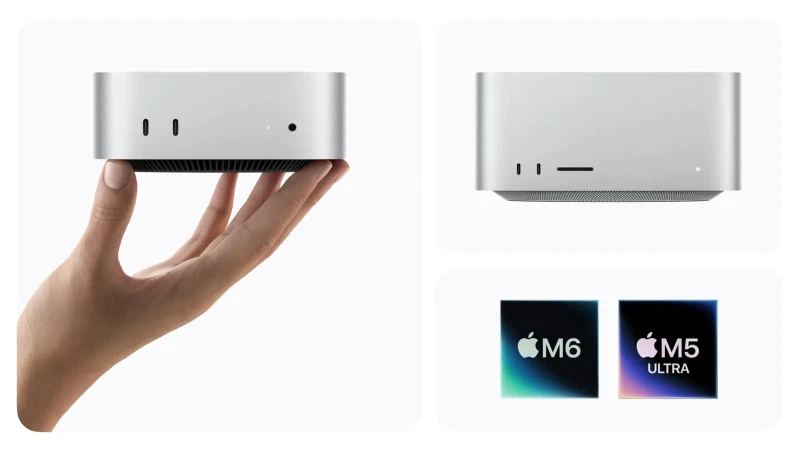
Apple has started shipping an updated Mac mini and a new Mac Studio topping out at the M5 Ultra chip. Apple says the configuration lets “AI researchers run enormous LLMs entirely on device,” citing up to 512GB of unified memory and 1.2TB/s of memory bandwidth on the top Mac Studio.

The Mac mini starts with a 12-core M6 chip, a 12-core GPU with Neural Accelerators in every core, and a dual 16-core Neural Engine, running 16GB of unified memory at up to 170GB/s of bandwidth. A Mac mini with the M5 Pro chip steps up to an 18-core CPU, a 20-core GPU and up to 64GB of memory at 307GB/s. Apple prices the M6 Mac mini from $899 and the M5 Pro model from $1,699.

The Mac Studio comes in M5 Max and M5 Ultra configurations, with the Max offering an 18-core CPU and up to a 40-core GPU with up to 128GB of unified memory, starting at $2,499. The M5 Ultra model reaches a 36-core CPU, an 80-core GPU and up to 512GB of memory, starting at $5,499. Apple says Thunderbolt 5 with Remote Direct Memory Access lets multiple Mac Studio systems cluster together, giving up to 3x faster performance for distributed AI inference compared with a single system.

The new Mac mini and Mac Studio models became available on September 22, running macOS 27 with Apple Intelligence and Siri AI features. Apple also offers leasing plans starting at $48.99 a month for the M5 Max Mac Studio and $110.10 a month for the M5 Ultra model over 36 months.

MediaTek launches Dimensity CX C10 Max, a 55 TOPS chip for Googlebook

MediaTek has launched the Dimensity CX C10 Max, the first chip in a new “Compute Experiences” line built for Googlebook, Google’s laptop category, alongside chips from Intel and Qualcomm. Built on a 3nm process, it pairs an eight-core Arm CPU and an 11-core GPU with MediaTek’s NPU 890, which the company rates at up to 55 TOPS.

The CPU uses an all-big-core layout with one Cortex-X925 core at up to 3.73 GHz, three Cortex-X4 cores and four Cortex-A720 cores, backed by 12 MB of L3 cache and 10 MB of system-level cache, according to MediaTek’s product page. The 11-core Arm Immortalis-G925 GPU supports LPDDR5X memory at up to 9,600 Mbps and UFS 4.0 storage. MediaTek pitches the chip for on-device agentic AI, including multimodal, real-time workflows such as live transcription and summarization that it says run locally without sending data to the cloud. A separate Imagiq 1090 image processor supports sensors up to 32MP.

Tom’s Hardware reports that the C10 Max’s CPU, GPU and NPU configuration is nearly identical to the Kompanio Ultra 910 already used in Chromebook Plus devices. The outlet notes the Cortex-X925 clock rises only from 3.62 GHz to 3.73 GHz, LPDDR5X speed from 8,533 to 9,600 Mbps, and NPU throughput from 50 to 55 TOPS, despite MediaTek’s framing of the chip as elevating its computing portfolio.

Vince Hu, MediaTek’s senior vice president, said the chip is “designed for the next wave of intelligent computing, combining flagship performance and power-efficient processing.” MediaTek’s release names no pricing or launch date for Googlebook devices using the C10 Max, saying only that it enables thinner, lighter, fanless laptop designs with all-day battery life.

Qualcomm launches Snapdragon 8 Elite Extreme Gen 6 for 30B-parameter AI

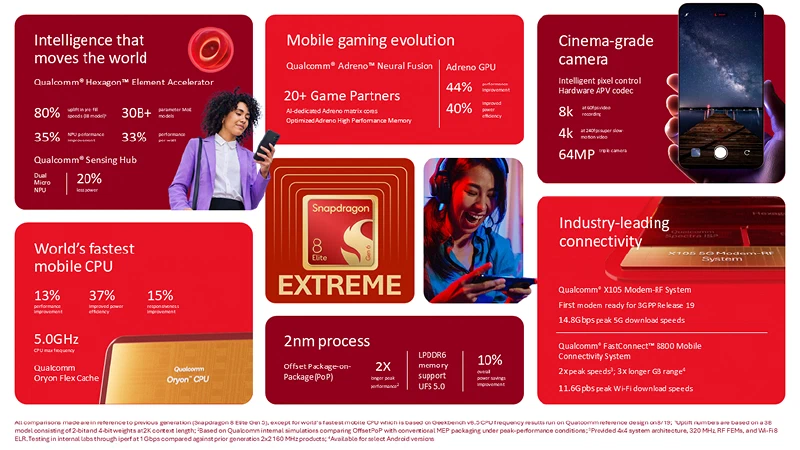
Qualcomm has announced two flagship mobile chips, the Snapdragon 8 Elite Gen 6 and a pricier Snapdragon 8 Elite Extreme Gen 6, both built on a 2nm process and positioned around what the company calls the “agentic AI” era. The Extreme model’s Hexagon NPU carries 50% more shared memory than the standard chip, which lets it run mixture-of-experts models, where only part of the model activates per token, with more than 30 billion parameters directly on a phone, according to Computerbase. Qualcomm calls the chips’ Oryon prime cores, which reach 5.0 GHz, the first smartphone CPU cores to cross that clock speed, according to Tech Advisor.

The fourth-generation Oryon CPU pairs two prime cores at 5.0 GHz with six performance cores at 4.0 GHz, sharing a single 16 MB cache pool that replaces the previous generation’s split 12+12 MB layout. Qualcomm claims 10% higher CPU performance on the Elite and 13% on the Extreme. The Adreno GPU clock rises to 1.45 GHz from 1.2 GHz, with reported gains of 35% and 44%, and the Extreme adds Matrix Cores for a feature called Adreno Neural Fusion, which handles AI-based upscaling and frame generation that the standard Elite lacks, according to Xenospectrum.

The Hexagon NPU keeps the same 12 scalar and 8 vector units as the previous generation but adds a new tensor unit and a redesigned Element Accelerator for element-wise tensor operations. Xenospectrum reports NPU performance gains of 35% on the Extreme and 14% on the standard Elite, with efficiency improvements of 33% and 20% respectively. Qualcomm frames the extra NPU memory and efficiency around “everyday agents” that respond faster, adapt to the user and learn throughout the day, with an enhanced Sensing Hub handling always-on, on-device voice processing.

Honor, Motorola, OnePlus, Oppo, Vivo and Xiaomi are confirmed adopters, while Samsung was notably absent from Qualcomm’s list. Tech Advisor names the Motorola Signature 27 as the first confirmed device. The chips also add support for LPDDR6-10600 memory alongside existing LPDDR5X-10600, and UFS 5.0 storage that doubles per-lane transfer rates to 46.4 Gbit/s, according to Computerbase.

Qualcomm infographic with six panels covering the Hexagon Element Accelerator, the Oryon CPU, Adreno Neural Fusion gaming features, the 2nm process, camera capabilities and the X105 modem and FastConnect 8800 connectivity system
Qualcomm's own figures for the Snapdragon 8 Elite Extreme Gen 6, including the Element Accelerator's 30B+ parameter MoE support and the 5.0 GHz Oryon CPU. Credit: Qualcomm