All updates

News and context on AI running on mobile devices.

Thursday 11 June 2026

llada.cpp runs a diffusion LLM on a Snapdragon NPU up to 42 times faster

Tuowei Wang, Yanfan Sun and Ju Ren of Tsinghua University and Beihang University published llada.cpp on June 11, 2026, an inference framework that runs diffusion language models on a phone’s NPU. On an OnePlus Ace5 Pro with a Snapdragon 8 Elite, the authors measure LLaDA-8B-Instruct generating 128 tokens 38 times faster than the same model on the phone’s CPU for GSM8K prompts and 42 times faster on BoolQ, and they report a range of 17 times to 42 times across their phones and tasks. The same figure puts Llama-3-8B-Instruct on the NPU at 19 to 21 times that CPU baseline, and the authors state that llada.cpp runs LLaDA-8B up to 3.9 times faster than an autoregressive model of the same size.
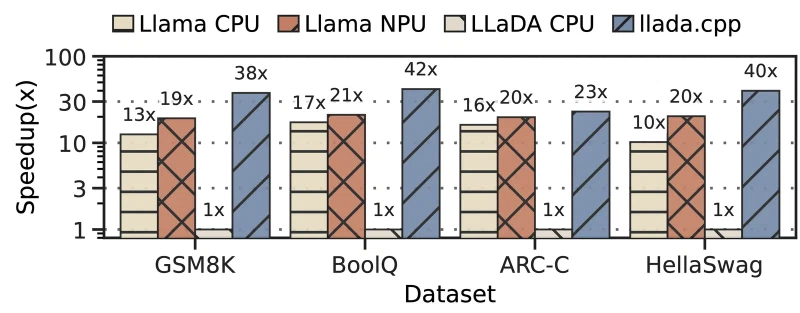
Bar chart of 128-token generation speedup on a Snapdragon 8 Elite phone across GSM8K, BoolQ, ARC-C and HellaSwag, with LLaDA on the CPU at 1x, Llama-3-8B on the NPU at 19x to 21x, and llada.cpp at 23x to 42x
Chart: Wang, Sun and Ren, CC BY 4.0.

A diffusion language model does not emit one token after another. It starts from a block of masked positions, 32 tokens by default here, and refines all of them together over repeated denoising steps, committing the positions it is most confident about and carrying the rest into the next step. That turns decoding into a run of large matrix operations, which is the work a mobile NPU is built for, while autoregressive decoding hands the NPU one token’s worth of work per step. The cost the paper identifies is that every denoising step recomputes the full sequence, so the parallel work gets repeated many times over.

llada.cpp is built on llama.cpp and targets Qualcomm’s Hexagon NPU with 4-bit weights. Once a block is nearly done only a few masked tokens are left, so the framework pulls tokens from the next block into the same NPU pass to keep it full, keeps already committed tokens open to revision and repairs the unstable ones on the CPU while the NPU carries on, and repacks the limited address space the NPU can see so weights and cache do not have to be remapped between steps. The authors’ breakdown of a 128-token GSM8K request on the Snapdragon 8 Elite puts it at 2996.2 s on the CPU, 607.0 s once the prefix KV cache is reused, and 16.1 s with the full framework.

Accuracy moves in both directions. Measured on 200-sample subsets against LLaDA-8B-Instruct on the CPU, the authors’ table has GSM8K rising from 39.0 to 43.5 and ARC-C from 84.0 to 85.0, while BoolQ falls from 82.5 to 80.5 and HellaSwag from 51.0 to 49.5, and their ablation shows the borrowed future-block tokens costing accuracy on all four tasks before the CPU-side revision path recovers it. The work covers three 16 GB phones, an OnePlus 12 with a Snapdragon 8 Gen 3, the Ace5 Pro, and an OnePlus 15 with a Snapdragon 8 Elite Gen 5, and the authors state that on the Snapdragon 8 Gen 3 their framework is still slower than Llama-3-8B at 128 tokens and only pulls ahead on the two newer chips. The paper is on arXiv under CC BY 4.0 and names no code release.
Wednesday 10 June 2026

CAPED redacts phone screenshots before a cloud GUI agent sees them

Researchers at the Chinese University of Hong Kong, Southeast University and Shandong University published CAPED on June 10, 2026, a filter that blacks out parts of a phone’s screenshots before they reach a cloud-hosted GUI agent. Across a 28-task privacy suite the authors built themselves, weighted seeded leakage falls from 0.766 with raw screenshots to 0.268 with the filter in front, counted only on runs where the agent still finished its task. A multimodal model plays the attacker and scores what it can still infer from the whole screenshot sequence, not from single frames.

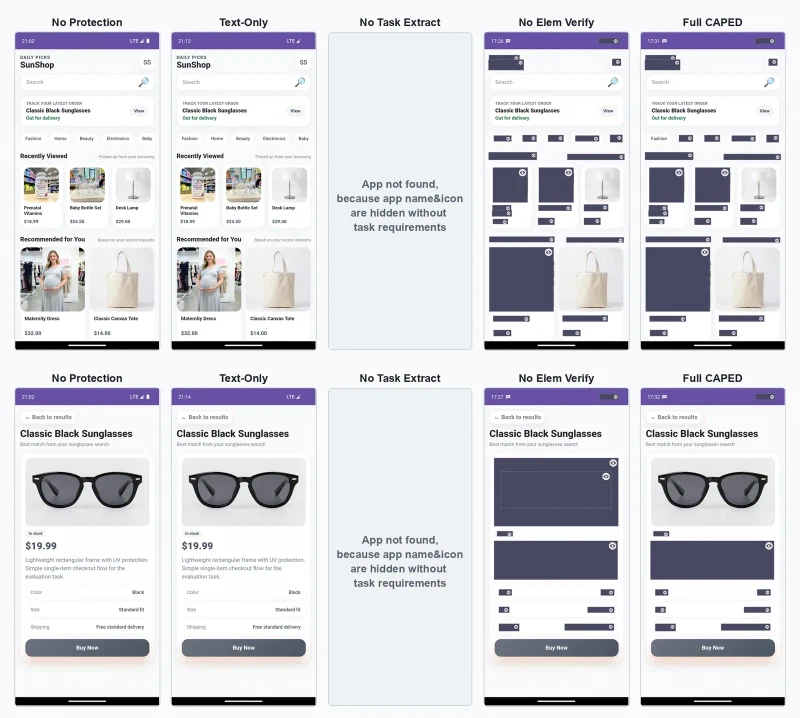
A screenshot-based agent operates a phone the way a person does, by looking at the screen, so every image it uploads carries whatever happens to sit next to the thing the user asked for. The authors call this incidental visual privacy exposure and name contacts, message previews, non-target photos, filenames, recommendation feeds and health widgets as content the remote model receives although the user never mentioned it. In one of their test shops, a request to buy sunglasses puts prenatal vitamins, a baby bottle set and a maternity dress in front of the model, because the shop’s recommendation rows share the page with the product. Stripping names and numbers out of the text does not close that gap, and the authors measure text-only anonymisation at 0.752 against 0.766 for no protection at all.

Ten phone screenshots in two rows comparing five protection methods on a shopping task, with prenatal vitamins, a baby bottle set and a maternity dress visible under No Protection and Text-Only, hidden behind grey masks under Full CAPED while the sunglasses product page stays readable, and the whole app unreachable when task extraction is removed
Figure: Shen et al., licensed CC BY 4.0. The mock SunShop task asks the agent to buy sunglasses, so the personalised rows around it count as incidental exposure.

CAPED decides per interface element rather than per screen, according to the paper. It first sorts the current screen into one of three postures, so galleries, maps, files and financial views show their text but hide their images, while messaging, contacts, feeds and health dashboards hide both by default. The user’s instruction is turned into a short list of what the agent is allowed to need, and a hidden element is released only when it matches that list, checked either by text matching or by asking a vision model whether a cropped thumbnail really shows the requested subject. Hidden areas keep their place in the layout under a solid overlay with an eye icon, and names in exposed text are replaced by placeholders the remote agent can still follow.

The defence is meant to run on the phone, and the authors argue the instruction has to be interpreted locally too, since it can name people, relationships, locations and intentions before any screen policy applies. The prototype they measured does not run on a phone. They state that CAPED’s components ran on the evaluation host with an evaluation-side service for the heavier models, and that the timings should be read as live-loop prototype latency rather than physical-phone latency, energy or thermal behaviour. Over 1,394 measured steps the privacy work added 2.325 seconds per agent step, 22.6 percent of a 10.835-second step, most of it the detector at 1.811 seconds, plus 5.716 seconds once per task to extract the requirements.

The protection also costs task success. On AndroidWorld’s 116 ordinary tasks, GUI-Owl-7B completed 77 of them (66.4%) unprotected and 64 (55.2%) behind the full filter, which the authors call a prototype-level utility cost. They name further limits themselves, writing that screens their rule base does not cover fall back to the most permissive posture, which they describe as not privacy-conservative, and that open-ended requests such as finding the latest receipt widen exposure and account for much of the leakage that remains. On the connected Gmail, Drive and Photos tasks the filter moves leakage from 0.402 to 0.347 only, the interactive unmasking path was never tested with real users, and the authors write that they plan to release the CAPED artifact in a future public version.

Wednesday 27 May 2026

Apertus Mini distils an open-data 8B into 0.5B, 1.5B and 4B models

Researchers working in the Swiss AI Initiative published a technical report on May 27, 2026 describing three language models distilled from Apertus 8B, at 0.5B, 1.5B and 4B parameters. The authors are based at EPFL, ETH Zurich and ISTA, and the models sit on Hugging Face as the Apertus Mini collection. They inherit what the project calls a fully open and compliant release, meaning published weights, published data pipeline and published recipe, with pre-training restricted to openly available data that honours robots.txt opt-outs. The model card lists 1,811 natively supported languages.

Each instruction-tuned model also ships in MLX format at 3, 4 and 6 bits, which the authors aimed at Apple devices and at memory-limited mobile and edge deployment. The 4-bit 4B weights are a 2.59 GB file against 7.65 GB for the same model in bfloat16, and the 1.5B and 0.5B come to 1.08 GB and 0.31 GB. The authors build the quantised copies with quantisation-aware distillation, a short recovery run that retrains the compressed weights against the 8B model’s own output distribution, and report 90% to 104% of the unquantised few-shot accuracy on ARC, HellaSwag, MMLU and WinoGrande. Separate FP8 and NVFP4 checkpoints target NVIDIA GPUs instead.

The base model table averages ARC, HellaSwag, WinoGrande, XNLI, XCOPA and PIQA, and puts the three sizes at 51.79, 56.66 and 61.53 against 64.96 for the 8B teacher. The same table gives the Qwen3 base models 52.23, 57.51 and 62.14 at comparable sizes, so the distilled models land just under them on the average while leading on the two cross-lingual sets, 45.03 against 43.00 on XNLI and 63.82 against 61.82 on XCOPA at 4B. On a multilingual average of MMLU, TruthfulQA, ARC, instruction following and LogiQA for the instruction-tuned models, the authors report 0.318, 0.382 and 0.473 against 0.401, 0.457 and 0.521 for Qwen3 and 0.497 for Gemma 3 4B, and write that the family is weaker at instruction following and maths.

Each model saw 1.7T tokens taken from the final and most heavily filtered phase of the original Apertus data, with no new sources added, packed into 4,096-token sequences and trained on 64 GH200 GPUs at the Swiss National Supercomputing Centre. The cost table puts the 4B run at 2.0E22 FLOPs and the single pass that produced the teacher’s logits for all three students at 1.4E22, against 3.7E23 FLOPs for the original Apertus 8B pre-training on 15T tokens, which the authors describe as making the whole family cost under 12% of the teacher. Swiss AI released 24 checkpoints in total, base, instruction-tuned and quantised, under the Apache 2.0 licence with an acceptable use policy attached, along with the training, post-training and quantisation code.

Tuesday 26 May 2026

Meta AI builds MobileMoE, 5.3B parameters with 0.9B active per token

Meta AI published MobileMoE on May 26, 2026, a family of three language models for phones that hold 1.3B, 2.8B and 5.3B parameters but run only 272M, 528M and 922M of them on any given token. Each one is a sparse mixture of experts, meaning the feedforward block in every layer is split into 60 small networks plus one always-on shared network, and a router picks 4 of the 60 for each token while the rest sit idle. Per-token compute therefore follows the active count, and the memory footprint follows the total.

That split is what makes the models awkward to host on a phone. The authors quantise all three to 4 bits with quantisation-aware training, which puts the weights at 0.68 GB, 1.48 GB and 2.75 GB, because every expert has to be reachable even though only a few run per token. On a Samsung Galaxy S25 they measure peak resident memory during inference at 1.49 GB for the smallest model at an 8k context against 1.91 GB for the dense MobileLLM-Pro, and at 4.71 GB for the largest. Sizing the whole expert set to fit phone DRAM is the opposite of the route Edge0 takes, which streams expert weights off storage to keep a 35B model inside a couple of gigabytes.

The paper reports that peak memory under real prompts runs 1.2 to 2.1 times higher than under repeated dummy tokens for the mixture-of-experts models, while staying flat for the dense baseline, because varied input routes to more experts and pulls more of them into RAM. Meta AI therefore profiled with real code, knowledge and maths prompts and calls dummy-prompt figures a lower bound rather than a measurement.

The authors ran the models through ExecuTorch on the Galaxy S25 with a Snapdragon 8 Elite on 4 CPU threads and on an iPhone 16 Pro with an A18 Pro on 2 CPU threads, after writing a fused mixture-of-experts operator because mobile CPU backends ship none. On a 512-token prompt they measure the smallest model decoding at 130.0 tok/s on the Galaxy S25 against 56.5 for MobileLLM-Pro, and at 180.5 tok/s on the iPhone 16 Pro against 55.1. Time to first token on a 1k prompt drops from 4.26 s to 2.01 s on the Galaxy and from 6.03 s to 2.14 s on the iPhone. Across both phones, CPU and GPU, and the XNNPACK and MLX backends, Meta AI reports the smallest model running 1.8 to 3.8 times faster at prefill and 2.2 to 3.4 times faster at decode than the dense baseline at comparable 4-bit weight memory.

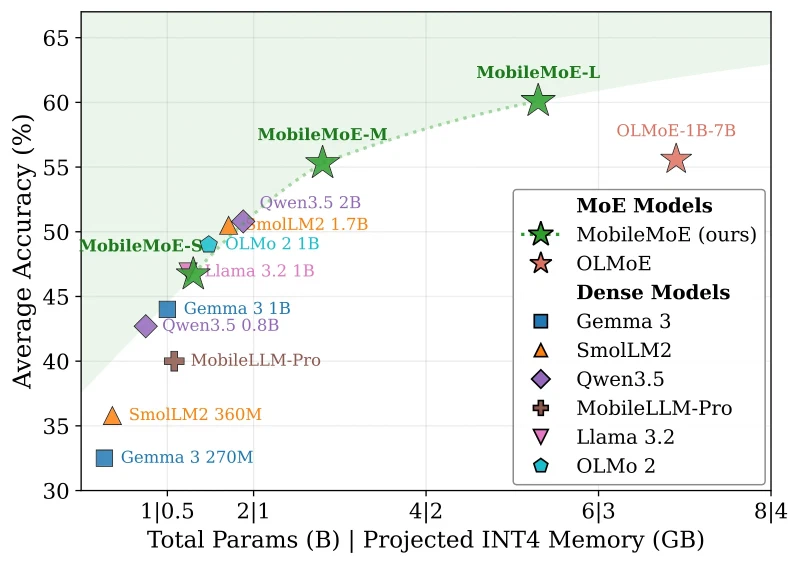
Across 14 benchmarks the authors score the instruction-tuned models at 46.7, 55.3 and 60.1 on average at 16-bit precision, against 42.7 for the dense Qwen3.5 0.8B, 44.0 for Gemma 3 1B, 46.9 for Llama 3.2 1B and 50.8 for Qwen3.5 2B, the last of which carries 1.9B active parameters. The largest model reaches 60.1 against 55.6 for Ai2’s OLMoE-1B-7B, with 30 percent fewer active and 23 percent fewer total parameters. After 4-bit quantisation those averages fall to 44.0, 52.5 and 57.8, which leaves the smallest model 1.5 points behind MobileLLM-Pro at 45.5 while scoring 9.4 points higher on MMLU. Meta AI states that the training data across all four stages comes from openly licensed public datasets, names no weight release, and lists mobile NPU deployment, expert pruning and mixed-precision quantisation as further work.

Scatter chart of average accuracy over 14 benchmarks against total parameters and projected 4-bit memory, with MobileMoE-S, M and L on a curve above the dense models and to the left of OLMoE-1B-7B
Chart: Meta AI. The authors' own comparison of instruction-tuned models at 16-bit precision, with the horizontal axis giving total parameters alongside the 4-bit weight footprint those imply.

Prism ML releases Bonsai Image 4B, a 1-bit image model that runs on iPhone

Prism ML has released Bonsai Image 4B, an image generation model with 4 billion parameters in a 1-bit and a ternary version. The company says it is the first image model in its parameter class to run directly on an iPhone. It generates a 512x512 image in 9.4 seconds on an iPhone 17 Pro Max and in about 6 seconds on an M4 Pro Mac, where Prism reports up to 5.6 times the speed of the stock full-precision MFLUX pipeline.

Collage of twelve generated images including an owl illustration, an astronaut holding a bonsai tree on the Moon and a lighthouse in a storm
Sample images from the Bonsai Image 4B announcement. Credit: Prism ML

The diffusion transformer takes 0.93 GB in the 1-bit version, which uses 1.125 effective bits per weight, and 1.21 GB in the ternary version at 1.71 bits. Prism lists 7.75 GB for the comparison model FLUX.2 Klein 4B. The full deployment payload on Apple Silicon is 3.42 GB and 3.88 GB, against 15.97 GB for FLUX.2 Klein 4B. At runtime, 512x512 generation uses 1.5 GB and 1.96 GB against 11.74 GB, and 1024x1024 generation uses 1.95 GB and 2.38 GB against 14.39 GB.

Prism scores the ternary version at 0.723 on GenEval, 12.22 on HPSv3 and 0.851 on DPG-Bench, which it summarizes as 95% of FLUX.2 Klein 4B overall. The 1-bit version scores 0.671, 11.15 and 0.822, or 88%, while FLUX.2 Klein 4B scores 0.819, 12.84 and 0.853. GenEval measures object composition and attribute binding, HPSv3 human preference and DPG-Bench how well dense prompts are followed.

The models run on iPhone, iPad and Mac via MLX low-bit paths and on CUDA GPUs via Gemlite low-bit kernels. They are released as open weights and code under the Apache 2.0 license, and Prism ships the iOS app Bonsai Studio for trying the model on iPhone. Weights are in the Hugging Face collection, code is in the GitHub repository, and a WebGPU demo runs in the browser.

Tuesday 19 May 2026

LiteRT-LM reports 52 decode tokens per second for Gemma 4 E2B on an Android GPU

Google has detailed LiteRT-LM, the runtime it uses to run Gemma 4 on-device in Chrome, ChromeOS, the Pixel Watch and the Google AI Edge Gallery app. It sits on top of LiteRT, formerly TensorFlow Lite, and adds GenAI libraries over the XNNPACK and ML Drift kernels.

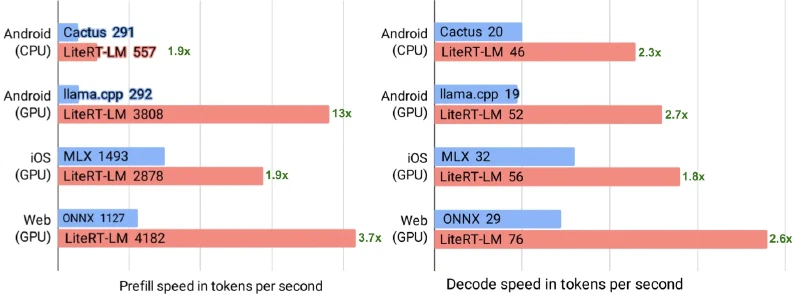
Running Gemma 4 E2B without multi-token prediction, Google measures 52 decode tokens per second on the Android GPU through OpenCL, 56 on iOS through Metal, and up to 76 in the browser on WebGPU. The Android figures come from a Samsung S26 Ultra, iOS from an iPhone 17 Pro, and web from Chrome on a 2024 MacBook Pro with an M4 Max.

Two bar charts comparing prefill and decode speeds of LiteRT-LM against Cactus, llama.cpp, MLX and ONNX on Android, iOS and web
Chart: Google.

The published comparison puts LiteRT-LM prefill at 3,808 tokens per second against 292 for llama.cpp on the Android GPU, 2,878 against 1,493 for MLX on iOS, and 4,182 against 1,127 for ONNX on the web. Decode figures in the same chart are 52 against 19, 56 against 32 and 76 against 29.

Multi-token prediction raises decode further. Google reports up to a 2.2x speedup, taking Gemma 4 E2B from 52 to 85 tokens per second and E4B from 21 to 47, measured on a Samsung S26 Ultra GPU. The drafter and the primary model run on the same hardware block so the shared KV cache and activations stay in local memory.

Table listing baseline and multi-token prediction decode speeds for Gemma 4 E2B at 52 and 85 tokens per second and E4B at 21 and 47
Chart: Google.

On memory, LiteRT-LM keeps per-layer embeddings out of memory and loads image and audio encoders only when a task needs them. Google states that the 2.58 GB Gemma 4 E2B model runs with a physical footprint of 607 MB on Apple mobile CPUs using XNNPACK weight caching.

For agentic use the runtime supports Thinking Mode, which developers can stream to the interface or strip to save KV cache space:

By dedicating a scratchpad for step-by-step reasoning before the model commits to an action, LiteRT-LM can significantly improve the output quality.

Constrained decoding enforces JSON schemas on tool payloads, and native function calling pauses execution, returns the tool-call request to the app and resumes on the tool’s output. Session save and restore serialise KV cache state so long conversations skip the prefill phase on return.

Beyond the existing Kotlin and C++ interfaces on Android, Google is adding an open-source Swift API for Apple platforms and a JavaScript API for the web through WebAssembly and WebGPU.

Quant.npu runs 4-bit LLMs up to 15.1 percent faster on a Qualcomm NPU

Eight authors published Quant.npu on May 19, 2026, a way of quantising 1B to 3B language models so they run on a phone’s neural processing unit with no rescaling at runtime. On a Qualcomm SM8650 NPU they measure their 4-bit weight, 8-bit activation build of Llama-3.2-3B-Instruct finishing up to 15.1 percent faster than the same model under ExecuTorch’s 4-bit per-block weights with 16-bit activations, for about 1 percentage point of zero-shot accuracy. Across every model and task in the paper the authors put the average cost at a 2.58 percent accuracy drop and a 1.23 rise in perplexity.

Quantisation stores a tensor as small integers plus a scale factor that maps them back to real values. Most published 4-bit methods, including the QuaRot and SpinQuant work Quant.npu is measured against, work that scale out while the model runs by scanning each activation tensor for its largest value. A mobile NPU compiles its graph before the model ships and expects every scale to be fixed by then, because that scan is a reduction the hardware is poor at, at least 7 vector instruction cycles for a 128-element 8-bit vector by the authors’ count, and because two of the four rotation steps these methods use against outliers need floating-point matrix multiplications during inference, which the paper puts at roughly double the compute. Anything left dynamic therefore has to run outside the compiled integer pipeline, and the authors report that simply freezing a model optimised under dynamic quantisation costs 15.61 percent accuracy on SmolLM2-1.7B-Instruct.

Quant.npu learns the scales during optimisation instead and folds its two rotation matrices into the weights offline, so the shipped graph is integer arithmetic end to end. In the paper’s main table for Llama-3.2-3B-Instruct at 4-bit weights and 8-bit activations, that lifts average zero-shot accuracy across six benchmarks to 58.27 percent against 46.23 for SpinQuant and 47.66 for QuaRot in the same static setting, with perplexity on C4 falling from 28.78 to 19.16. Against the slower ExecuTorch configuration it beats on latency, though, Quant.npu is the one behind, scoring lower on five of the six benchmarks, 1.08 points lower on average and 0.97 higher in perplexity, and FP32 stays ahead of both at 61.3 percent.

On the newer SM8750 NPU the authors report peak memory of 1876 MB to 1985 MB for their 3B builds against 2216 MB to 2435 MB for ExecuTorch, and prefill of 969.72 tok/s for Qwen2.5-3B-Instruct on the DroidTask set against 808.10. They name two limits of their own, that the pipeline still keeps a few operations such as the SiLU activation at 16 bits to hold accuracy, which they call a bottleneck against a fully low-bit pipeline, and that they use no method for picking calibration data even though the optimisation is sensitive to it. Quantising Qwen3-1.7B takes about 2.5 hours on NVIDIA A40 GPUs, and the preprint announces no code release.

Wednesday 29 April 2026

Tencent open-sources a 440 MB offline translation model for phones

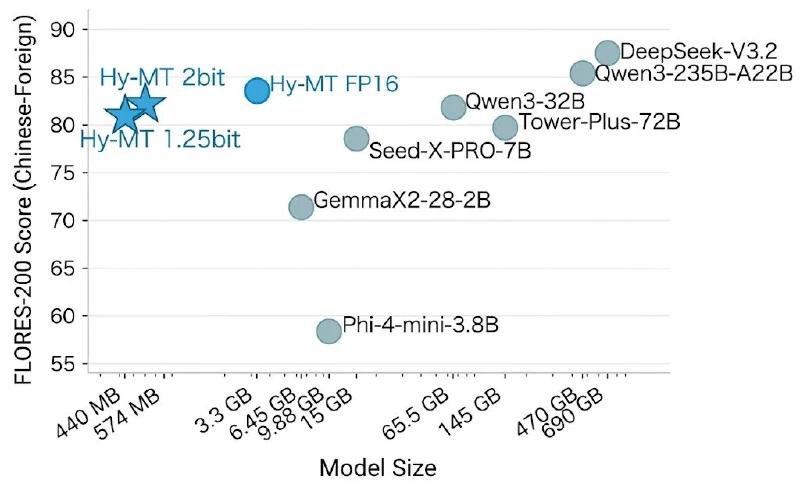
Tencent Hunyuan has open-sourced Hy-MT1.5-1.8B-1.25bit, a translation model that runs fully offline on a phone. Quantisation to 1.25 bits cuts the file from 3.3 GB at FP16 to 440 MB; a 2-bit build is 574 MB. The announcement states the result is 25 percent smaller and around 10 percent faster than prior 1.67-bit approaches with no loss of accuracy.

Scatter chart plotting FLORES-200 score against model size, with Hy-MT at 440 MB near models of 470 GB and 690 GB
Chart: Tencent Hunyuan.

The compression uses Sherry, a ternary quantisation framework with 3:4 fine-grained sparsity: of every four weights, the three most important are stored in 1 bit as -1 or +1 and the fourth is zeroed. A custom STQ kernel aligns the format to the SIMD instruction set of mobile CPUs. Running it requires llama.cpp with STQ1_0 kernel support, added in pull request 22836, and the model card links a side-by-side speed demo recorded on a Snapdragon 888 with 8 GB of RAM.

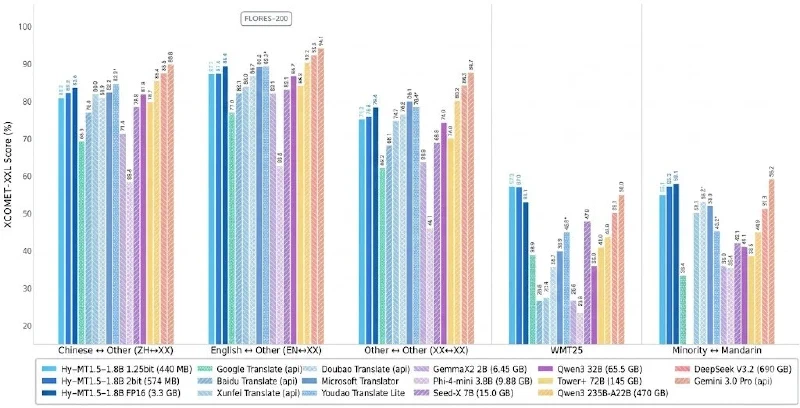
The model covers 33 languages, 5 dialects and minority languages, and 1,056 translation directions, including Tibetan and Mongolian. On the FLORES-200 benchmark Tencent reports it ahead of Tower-Plus-72B, Qwen3-32B, Microsoft Translator and Doubao on Chinese-to-foreign pairs, and the announcement claims it outperforms Google Translate and matches 235B-scale models.

Bar chart of XCOMET-XXL scores across five translation categories comparing Hy-MT builds with commercial APIs and larger open models
Chart: Tencent Hunyuan.

Weights are on Hugging Face alongside an Android demo APK for offline translation. The code is released under the AngelSlim licence rather than a standard open-source licence.

Airgap is a React Native kit for support chatbots that answer offline

Xavier Puspus published Airgap on April 29, 2026, a React Native starter kit for branded customer support apps that have to keep answering when the network is slow, missing or deliberately blocked. Its configuration file pins a Gemma 4 E2B instruction-tuned model in Q3_K_S GGUF form, about 2.4 GB, which the app downloads on first launch and runs through llama.rn, the React Native binding for llama.cpp. The README states that Airgap searches bundled local documents first and uses a model only to phrase what that retrieval returned, and it lists Apple Foundation Models and Google’s ML Kit GenAI Prompt API as two further on-device answer providers an operator can put ahead of the downloaded file.

The repository ships seven example configurations, for airline, banking, electric utility, healthcare, insurance, telecom and water utility support, each with its own branding, prompts and JSON knowledge files, and the downloaded-model path targets iOS 15.1 and newer and Android API 24 and newer. Airgap is published under the MIT license. It is an early single-author project, with 54 commits and no tagged release, and almost all of the code arrived in one squashed initial commit followed by a burst of work in August 2026. The README lists physical-device evaluation of the Apple and Android system providers as an open release gate and labels the published demo recordings as Android emulator and iOS simulator footage rather than evidence of either system model running on a phone.

Thursday 16 April 2026

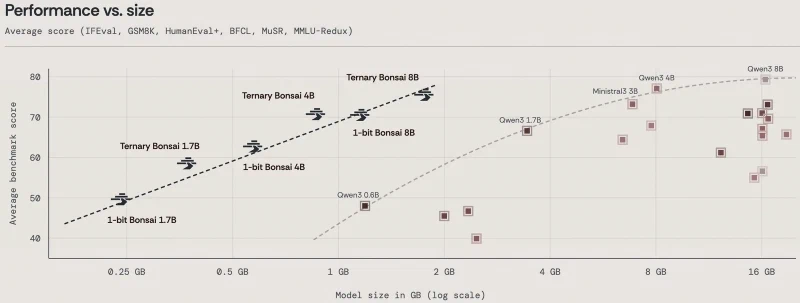
Prism ML releases Ternary Bonsai, 1.58-bit models with an 8B version at 1.75 GB

Prism ML has released Ternary Bonsai, a model family in 8B, 4B and 1.7B sizes that stores weights as -1, 0 or +1 instead of a single bit. Ternary Bonsai 8B needs 1.75 GB, which Prism says is about 9 times smaller than a standard 16-bit model. The scheme works out to 1.58 bits per weight, with each group of 128 weights sharing an FP16 scale factor, and it applies to the entire architecture.

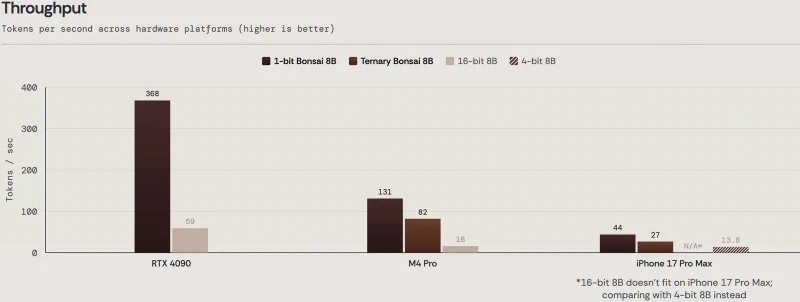
Prism reports 82 tok/s on an M4 Pro and 27 tok/s on an iPhone 17 Pro Max for the 8B model. A 4-bit 8B model reaches 13.8 tok/s on the same iPhone in the company’s chart. Energy use is 0.105 mWh per token on the M4 Pro and 0.132 mWh per token on the iPhone 17 Pro Max, which Prism says is 3 to 4 times better than 16-bit counterparts.

Ternary Bonsai 8B averages 75.5 across Prism’s benchmark set, compared with 70.5 for the earlier 1-bit Bonsai 8B, at about 600 MB more memory. The individual scores are 72.6 on MMLU Redux, 56.2 on MuSR, 91.0 on GSM8K, 77.4 on HumanEval+, 81.8 on IFEval and 73.9 on BFCLv3. According to Prism, only Qwen3 8B (16.38 GB) scores higher among the 8B-class models it compared, and the Bonsai model is 9 to 10 times smaller.

Scatter chart of average benchmark score against model size in GB, with 1-bit and ternary Bonsai models in 1.7B, 4B and 8B sizes on a line above the Qwen3 models
Average benchmark score against model size, as charted by Prism ML. Credit: Prism ML

The models are released under the Apache 2.0 license. They are available on Hugging Face and in the GitHub repository, which covers macOS, and run on Apple devices via MLX. On iPhone the iOS app Locally AI runs them, and a whitepaper describes the method.

Thursday 9 April 2026

Tempo compresses hour-long video with a 2B vision model so a 4B LLM can answer

Researchers at Meta AI and KAUST published Tempo on April 9, 2026, a way to hand a long video to a small vision-language model first and let a larger language model answer the question afterwards. On LVBench, a benchmark whose clips average 4101 seconds, the authors report their 6B system scoring 52.7 against 48.2 for VideoChat-Flash 7B, the strongest specialised baseline in their table, and against 30.8 for GPT-4o and 33.1 for Gemini 1.5 Pro.

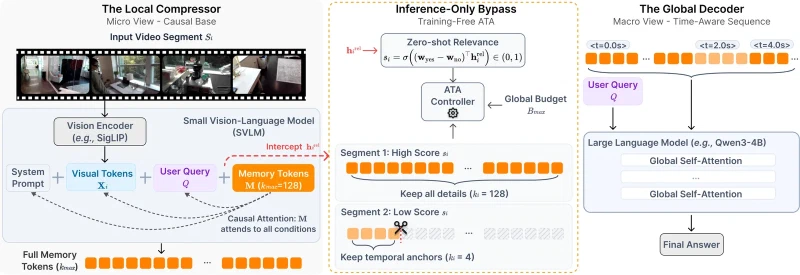
The small model does the reading and the large one does the reasoning. A Qwen3-VL-2B-Instruct compressor takes an eight-frame chunk of video together with the user’s question and writes out a short run of memory tokens that hold what the chunk contains, and a Qwen3 4B language model then reads the whole condensed sequence with timestamps attached and produces the answer. A linear projector joins the two, for 6B parameters in total. The compressor is the part that could in principle sit on a phone, since it never sees more than a few seconds of video at a time.

How many tokens each chunk gets is decided during the same forward pass. The authors insert a yes or no question about whether the segment is relevant to the query, read the difference between the two logits as a score, and keep more memory tokens for chunks that score high, spending between 0.5 and 16 tokens per frame under a fixed overall budget of 4K or 8K visual tokens. On LVBench under the 4K budget the measured average comes to 2.9 tokens per frame. The tighter budget also scores better than the looser one on that benchmark, 52.7 against 52.3, and on the long subset of Video-MME, 57.8 against 57.0. Raising the cap to 2048 frames and a 12K budget brings LVBench to 53.7.

Three-part diagram showing a small vision-language model turning a video segment and user query into memory tokens, an inference-only bypass scoring segment relevance and truncating low-scoring segments to four tokens, and a large language model reading the time-tagged sequence to produce the answer
Diagram: Fei et al., Figure 2 of the paper, licensed CC BY 4.0.

On the other three benchmarks the authors report 67.8 on Video-MME under the 4K budget against 65.3 for VideoChat-Flash and 61.9 for the Qwen3-VL 2B model the compressor starts from, plus 75.6 on MLVU and 65.1 on LongVideoBench. All of these are accuracy scores run through lmms-eval, not speed or memory figures. Nothing in the paper was measured on a phone, a tablet or any other edge device. Training used 32 and then 64 Nvidia H100 GPUs, the paper reports no latency, throughput or memory footprint for the compressor on mobile hardware, and the on-device case rests on the size of the model rather than on a measurement.

The authors state that all training datasets they used are publicly available, and they link code and a project page from the paper, with the repository carrying an Apache 2.0 license. They describe no weights release in the paper itself. Their stated next steps are to let the compressor decide for itself when it has gathered enough evidence to stop, which they say would bottleneck inference latency as things stand.

Thursday 2 April 2026

Gemma 4 lands on the edge with Agent Skills in Google AI Edge Gallery

Google DeepMind has launched Gemma 4 under the Apache 2.0 licence, and the Google AI Edge team has described how the E2B and E4B variants run on edge hardware. The models support more than 140 languages and a 128K context window.

Gemma 4 enables multi-step planning, autonomous action, offline code generation, and even audio-visual processing, all without specialized fine-tuning.

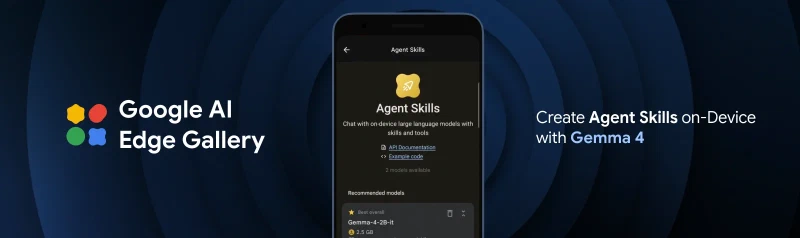
Promotional banner showing the Google AI Edge Gallery app open on the Agent Skills screen with Gemma-4-2B-it listed as a recommended model
Image: Google.

The Google AI Edge Gallery app on iOS and Android gains Agent Skills, which Google calls one of the first applications to run multi-step, autonomous agentic workflows entirely on-device. The examples given are querying Wikipedia, turning speech input into charts and flashcards, pairing photos with generated music, and building a small app that plays animal calls through conversation alone.

For in-app deployment Google points to LiteRT-LM. It reports that Gemma 4 E2B runs in under 1.5 GB of memory on some devices using 2-bit and 4-bit weights with memory-mapped per-layer embeddings, and that GPU optimisations process 4,000 input tokens across two skills in under 3 seconds. Constrained decoding enforces structured output, and dynamic context lengths let a single model span CPUs and GPUs.

On smaller hardware, LiteRT-LM reaches 133 prefill and 7.6 decode tokens per second on a Raspberry Pi 5 CPU, and 3,700 prefill and 31 decode tokens per second on the NPU of a Qualcomm Dragonwing IQ8, the processor behind the Arduino VENTUNO Q.

Gemma 4 is available with CPU and GPU support on Android and iOS, system-wide on Android through the new AICore Developer Preview, on Windows, Linux and macOS via Metal, and in the browser through WebGPU. Google also released a Python package and a litert-lm CLI for Linux, macOS and Raspberry Pi, with tool calling included.