All updates

News and context on AI running on mobile devices.

Saturday 16 November 2024

BlueLM-V-3B runs a multimodal model on a Dimensity 9300 NPU in 2.2 GB

Researchers at CUHK MMLab and vivo AI Lab published BlueLM-V-3B on November 16, 2024, a vision-language model designed together with the code that runs it on a phone. The authors deployed it on the NPU of a MediaTek Dimensity 9300 in a vivo X100 and report a peak memory requirement of 2.2 GB and a generation speed of 24.4 tok/s with the language model weights quantised to 4-bit.

The model pairs a 2.7B in-house BlueLM language model with a 400M SigLIP vision encoder that takes 384 by 384 image tiles. The authors report an average score of 66.1 on OpenCompass, a suite of eight multimodal benchmarks, which they state is the highest among models of 4B parameters or fewer, ahead of the 8B models MiniCPM-V-2.6 and InternVL2-8B.

Most of the speed comes from how the model decides what resolution to feed the encoder. Dynamic resolution schemes pick a grid of tiles to fit an image, and the authors show that existing choices enlarge pictures a lot, with LLaVA-NeXT resizing and padding a 394 by 390 image to 768 by 768, four times the area, and InternVL 1.5 stretching a 380 by 76 image to 1920 by 384, twenty-five times the area. More pixels mean more tiles and more image tokens, so BlueLM-V-3B uses what the authors call relaxed aspect ratio matching, which tolerates a slightly smaller effective resolution when it wastes less of the canvas. Both examples then land on a single 1:1 tile, and across the 665k-sample LLaVA training set the method picks a smaller grid than InternVL 1.5 in 523k cases.

The rest is shaped around what an NPU is bad at. The authors encode image tiles in batches of four at a time, which they measured as the fastest setting, and run the SigLIP convolution layer on the CPU in parallel with the transformer blocks on the NPU to hide 200 ms of latency. A downsampler merges every 2 by 2 patch into one token, cutting 729 tokens per tile to 196, and the prefill runs in chunks of 128 tokens rather than all at once. Precision is mixed, with INT4 for the language model weights, INT8 for the vision encoder and projector weights and for the KV cache, and INT16 and FP16 activations, which the authors say keeps accuracy stable because activations are more sensitive to quantisation than weights.

Against the 8B MiniCPM-V 2.5 running on the CPU of the same chip through llama.cpp, the authors report 2.53 s to load and encode a 768 by 1536 image and 2.7 s of prefill, versus 4.0 s and 13.9 s, at 24.4 tok/s against 4.9 tok/s. The paper describes no public release of weights or code, and the authors say future work will target a broader range of mobile devices.
Thursday 7 November 2024

PhoneLM searches for a fast architecture before training it and hits 58 tok/s

Researchers at Beijing University of Posts and Telecommunications published PhoneLM on November 7, 2024, a small language model family in 0.5B and 1.5B sizes built in an unusual order. The team first searched transformer configurations for the fastest inference on a specific phone, then pre-trained the configuration that won, instead of choosing a shape for capability and optimising speed after the fact. PhoneLM-1.5B decodes at 58 tok/s on the CPU of a Xiaomi 14 with a Qualcomm Snapdragon 8 Gen 3.

The search varied the layer count from 15 to 25, the ratio of intermediate to hidden size between 2 and 5 and the attention type, and the paper lists measured throughput for seven candidate 1.5B shapes on that phone. The winner has 19 layers and a hidden size of 2,560, a hidden size to layer ratio of 134.7 against the 54.6 to 88.6 the authors observe in recent small models. It uses ReLU rather than the SiLU activation most current small models adopt, which the authors argue is cheaper on NPUs built for integer arithmetic and leaves more zeros in the feed-forward output for sparse-computation tricks. The paper notes that only the 1.5B model went through the search.

Across seven zero-shot tasks including HellaSwag, PIQA, BoolQ and both ARC sets, the benchmark table puts PhoneLM-1.5B at an average of 67.31%, ahead of SmolLM-1.7B at 66.49% and StableLM 2 1.6B at 66.34% and behind DCLM-1.4B at 68.33% and Gemma 2 2B at 71.31%. PhoneLM-0.5B averages 60.43% against 60.17% for SmolLM-360M and 56.46% for OpenELM-450M. The authors measure PhoneLM-1.5B decoding 1.2 times faster than StableLM 2 1.6B and 1.6 times faster than SmolLM 1.7B on the same handset. The two models saw 1.1T and 1.5T training tokens, all of them from open datasets such as DCLM-baseline, StarCoderData and Dolma.

The group ran every device measurement through its own inference engine mllm, with the linear and embedding weights quantised to 4-bit and four threads pinned to the phone’s performance cores. On the NPU it goes through Qualcomm’s QNN framework, where the authors report prompt processing for PhoneLM-1.5B at 654 tok/s on the Xiaomi 14 against 602 tok/s for Qwen 2.5 1.5B. The 4-bit mllm build the group publishes is a 1.41 GB file. The paper states no peak memory figure.

An Android demo app on top of mllm runs PhoneLM-1.5B locally for chat and for Android intent invocation, so a user who asks to be woken at 8 o’clock has an alarm set through the system’s own alarm intent. That variant, PhoneLM-1.5B-Call, was fine-tuned with LoRA on DroidCall, 10,000 synthetic function-calling examples covering alarms, timers, email drafts and searches, and the paper places it above GPT-4o-mini, which scores 71.0% on the same test set. Weights are on Hugging Face under Apache 2.0 and the data preparation, training, fine-tuning and evaluation code is on GitHub under GPL-2.0, alongside the list of open datasets used at each stage.

Thursday 31 October 2024

Hugging Face trains SmolLM2 at 135M, 360M and 1.7B on up to 11T tokens

Hugging Face released SmolLM2 on October 31, 2024, a second generation of its small language models at 135M, 360M and 1.7B parameters. The company trained the 1.7B model on 11 trillion tokens, against 1T for the first SmolLM at the same size, and its model cards put the 360M model at 4T tokens and the 135M at 2T.

The mixture combines FineWeb-Edu, DCLM and The Stack with datasets Hugging Face curated for this run, which its paper from February 2025 names as FineMath for mathematics, Stack-Edu for code and SmolTalk for instruction tuning. That paper states the 1.7B run used a multi-stage schedule that held the highest quality maths and code data back for the final tenth of training, from 10T to 11T tokens, while the 360M and 135M models trained in a single stage on a mix kept consistent throughout. Hugging Face fine-tuned the instruct versions on SmolTalk and then tuned them further on ranked answer pairs from UltraFeedback.

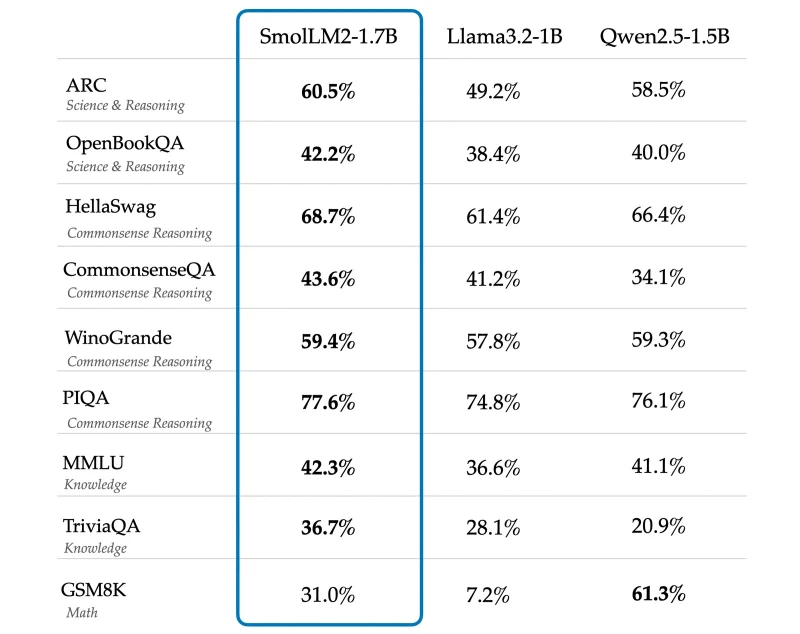
Hugging Face reports the 1.7B base model at 60.5 on ARC against 49.2 for Llama 3.2 1B and 58.5 for Qwen2.5 1.5B, 36.7 on TriviaQA against 28.1 and 20.9, and 19.4 on MMLU-Pro against 11.7 and 13.7, all run zero-shot with its own lighteval harness and printed in the model card. The instruct version scores 56.7 on the IFEval instruction-following test against 53.5 for Llama 3.2 1B Instruct and 47.4 for Qwen2.5 1.5B Instruct, while Qwen2.5 stays ahead on the MT-Bench chat test at 6.52 to 6.13. At the smaller sizes Hugging Face compares the 360M model with Qwen2.5 0.5B, reporting 53.0 against 45.4 on ARC and 16.9 against 4.3 on TriviaQA, and publishes no third-party comparison for the 135M model.

Table comparing SmolLM2-1.7B with Llama3.2-1B and Qwen2.5-1.5B on nine benchmarks, with SmolLM2 ahead on eight including ARC at 60.5 percent and TriviaQA at 36.7 percent, and behind Qwen on GSM8K at 31.0 against 61.3 percent
Table: Hugging Face's own figures for the base models.

The weight files run 269 MB for the 135M model, 724 MB for the 360M and 3.42 GB for the 1.7B in bfloat16, and Hugging Face uploaded 4-bit ONNX builds the same day at 118 MB, 273 MB and 1.11 GB, plus a 4-bit GGUF of the 1.7B instruct model at 1.06 GB. The repository says the models run locally through llama.cpp, MLX, MLC and transformers.js. All six checkpoints carry an 8k context window and the Apache 2.0 license.

Update, November 27, 2024. Hugging Face published a browser chat demo that runs the 1.7B instruct model through transformers.js and ONNX Runtime Web on WebGPU, with no server call after the download. Its local inference guide adds runnable code for llama.cpp, MLX and MLC, and lists the models on Ollama and in the PocketPal-AI phone app.

Friday 25 October 2024

Apple team finds H100 last on tokens per dollar for models up to 2B

Seven Apple researchers measured what it costs to train language models up to 2B parameters on rented Nvidia GPUs and found the most expensive card was the worst buy. The H100-80GB returned the fewest tokens per dollar of the three cards tested at every one of their four model sizes, 100M, 500M, 1B and 2B, while costing 2.53 times as much per hour as the A100-40GB.

The price scale comes from normalising published hourly rates at Lambda Labs and Google Cloud, with the A100-40GB set at 1.00 and the A100-80GB landing at 1.46. The same comparison shows cost efficiency falling as GPUs are added, with a single card the best or near-best point at all four model sizes. For the 1B model, tokens per dollar drop from about 17,000 on one GPU to about 10,300 on 64.

FlashAttention mattered more at small scale than at large. Reading the authors’ first figure, the 100M model gained roughly three times the tokens per dollar over vanilla attention, while at 2B the gain was under two times. The authors put this down to the cost of attention being quadratic in context length, so it dominates once the hidden dimension shrinks and the small models become bound by data movement between CPU and GPU and between GPUs. Vanilla attention also ran out of memory at a global batch size of 1024 on the 1B and 2B models, where FlashAttention did not.

Two habits carried over from large-model training did not pay off. Plain Distributed Data Parallel, which keeps a full copy of the model on every GPU, beat both sharded FSDP variants for the smaller models because it moves less data, and FSDP only pulled ahead at 2B, where it kept training at a global batch size that made DDP run out of memory. Filling the cards was not cost-optimal either, since the batch size figure peaks around a global batch size of 128 for the 100M model, 32 for 500M, 16 for 1B and 8 for 2B, in every case well short of what the memory allowed.

These are training runs on datacentre GPUs, not anything running on a phone, and the authors frame the work as guidance for labs with small budgets rather than for deployment. They name their own limits, running each setup at least three times for only 10 training steps, reporting normalised price ratios rather than absolute dollars, using no gradient accumulation, and leaving GPU utilisation and memory bandwidth measurements to future work. They also assume that settings such as the learning rate can be retuned to converge at whichever hardware configuration turns out cheapest. The 8-page paper is free to read on arXiv under the site’s non-exclusive distribution licence.

Wednesday 16 October 2024

Mistral puts Ministral 3B and 8B on devices with 128k context

Mistral AI introduced Ministral 3B and Ministral 8B on October 16, 2024, two models the company built for on-device computing and at-the-edge use and announced together as les Ministraux. Mistral says Ministral 3B already outperforms its own Mistral 7B on most benchmarks, and reports the base model scoring 60.9 on MMLU against 52.4 for Gemma 2 2B and 56.2 for Llama 3.2 3B.

Both models handle up to 128k tokens of context, which the announcement says was capped at 32k when run on vLLM. Ministral 8B uses what Mistral calls an interleaved sliding-window attention pattern, where a layer attends only to a limited span of recent tokens instead of the whole sequence, which the company says makes inference faster and lighter on memory.

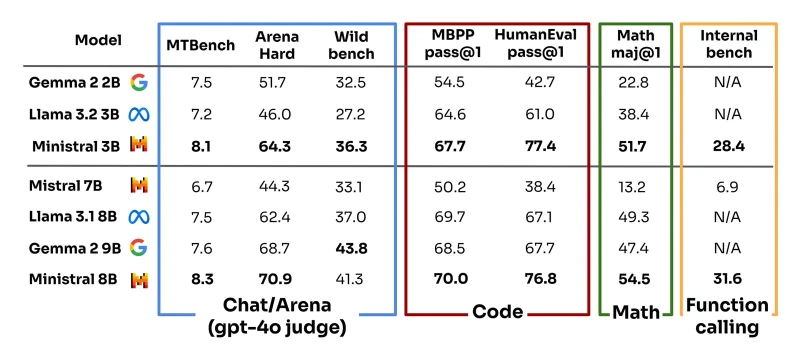
Mistral reports the instruction-tuned Ministral 3B at 8.1 on MTBench, 64.3 on Arena Hard and 77.4 on HumanEval, the last of those above Gemma 2 2B at 42.7 and Llama 3.2 3B at 61.0. Ministral 8B reaches 8.3 on MTBench and 70.9 on Arena Hard in the same table, while Gemma 2 9B stays ahead on WildBench at 43.8 against 41.3. All of these are Mistral’s own numbers, produced with an internal framework the company says it used to re-evaluate every model for the comparison.

Table of instruction-tuned scores across chat, code, math and function calling, with Ministral 3B and 8B in bold ahead of Gemma 2 2B, Llama 3.2 3B, Mistral 7B, Llama 3.1 8B and Gemma 2 9B in most columns
Table: Mistral AI's own figures, from its internal evaluation framework.

Mistral names on-device translation, smart assistants that work without an internet connection, local analytics and autonomous robotics as the applications customers and partners asked for, citing demand for local, privacy-first inference. The company also positions the two models as intermediaries in front of larger ones such as Mistral Large, tuned to parse input, route tasks and call APIs across multiple contexts in multi-step agent workflows.

Both models went live through Mistral’s API on the day of the announcement, at $0.04 per million tokens for Ministral 3B and $0.1 per million for Ministral 8B, with input and output priced the same. Mistral published weights for Ministral 8B Instruct only, for research use, and lists that model under both the Mistral Research License and the Mistral Commercial License, while Ministral 3B appears under the commercial license alone with no weights release. Anyone wanting to self-deploy either model has to contact Mistral for a commercial license, and the company says it will help with lossless quantisation for specific use cases.

Saturday 5 October 2024

PalmBench finds iPhones running local LLMs about three times faster than Android phones

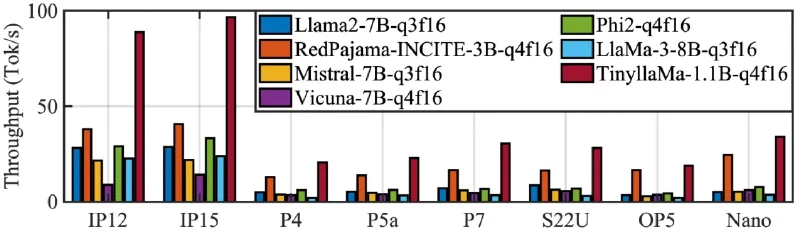
Researchers at the University of Wisconsin-Madison, Amazon Web Services AI and Uber ran quantised language models across eight phones and edge boards and measured the widest gap between Apple and everything else. In PalmBench, published as a conference paper at ICLR 2025, TinyLlama-1.1B at 4-bit reached close to 100 tok/s on an iPhone 15 Pro against roughly 30 tok/s on the fastest Android phone in the set, a Pixel 7. The authors report that the three-year-old iPhone 12 Pro also stayed ahead of every Android device and of Nvidia’s Jetson Orin Nano.

Bar chart of generation throughput in tokens per second for seven quantised models across eight devices, with both iPhones several times faster than the Pixels, the Galaxy S22 Ultra, the Orange Pi 5 and the Jetson Orin Nano
Chart: Li et al., licensed CC BY 4.0. Throughput measured with MLC LLM, which was the only framework that ran on all eight platforms.

The test bed covers a Pixel 4, Pixel 5a, Pixel 7, Galaxy S22 Ultra, iPhone 12 Pro, iPhone 15 Pro, an Orange Pi 5 and a Jetson Orin Nano, each with 6 GB or 8 GB of memory. Models include Llama-2-7B, Llama-3 and 3.1-8B, Llama-3.2-3B, Mistral-7B, Vicuna, Qwen2, Phi-2, Gemma-2-2B, RedPajama-INCITE-3B and TinyLlama-1.1B, quantised from 2-bit to 8-bit and additionally with GPTQ, AWQ and FasterTransformer. The team used two runtimes, MLC LLM and llama.cpp, and states that llama.cpp does not run on iPhone, so the cross-platform numbers come from MLC.

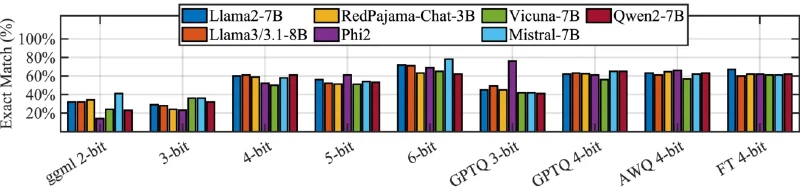
Quantisation costs more answer quality than the bit count alone suggests. Scoring each quantised build’s exact match against the unquantised model’s own answers on SQuAD and Natural Questions, the paper’s figure puts 4-bit builds between about 50 and 61 percent, 6-bit between roughly 62 and 78 percent, and 2-bit and 3-bit builds as low as 15 percent. The authors note that 3-bit did not clearly beat 2-bit, and that 5-bit landed close to 4-bit while consuming more resources and degrading more than any 4-bit variant.

Grouped bar chart of exact match rates for seven models across nine quantisation settings, showing 6-bit highest, 4-bit variants clustered near 60 percent, and 2-bit and 3-bit far below
Chart: Li et al., licensed CC BY 4.0. Exact match is measured against the answers of the same model before quantisation, not against ground truth.

The 4-bit builds drew more power than the 3-bit ones rather than less. The paper’s table records 4-bit consuming more energy on all eight devices for the same 3B Llama model, rising from 10.13 to 13.05 mWh on the iPhone 15 Pro and from 14.54 to 14.68 mWh on the Pixel 7, which the authors put down to the higher-precision build occupying more GPU duty cycles. Surface temperature measured with a FLIR C5 thermal camera peaked at 75.4 °C on the Orange Pi 5 and 46.3 °C on the iPhone 15 Pro at 4-bit. Harmful output tracked the bit count more cleanly, with the hallucination rate on Llama-3-8B at 34.7 percent for 2-bit against 9.1 percent for 4-bit GPTQ and 7.9 percent at 8-bit.

The authors name several limits on their own work. They cannot compare the two runtimes on iOS because llama.cpp does not support the iPhone, they profiled total memory only at 3-bit and 4-bit because higher-bit MLC builds exceeded the devices’ capacity, and they dropped models that would not fit at all, such as the unquantised Llama-2-7B at 13.11 GB. They also note that both runtimes expose few decoding options, with beam search unavailable in llama.cpp. Artificial Analysis has since run an independent benchmark of 33 quantised models on a single iPhone 17 Pro.

Friday 27 September 2024

AMD trains its first small language model, AMD-Llama-135M, on MI250 accelerators

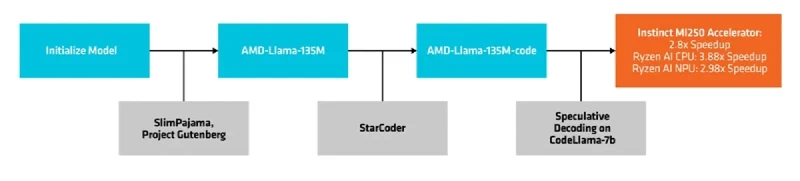
AMD released AMD-Llama-135M on September 27, 2024, its first small language model, at 135M parameters and trained from scratch on AMD’s own accelerators. AMD states that pretraining used 670B tokens drawn from SlimPajama and Project Gutenberg and took six days on four Instinct MI250 nodes holding four MI250 accelerators each. A second variant, AMD-Llama-135M-code, adds 20B tokens from the Python subset of StarCoder over another four days on the same hardware.

That code variant exists to work as a draft model for speculative decoding, where a small model guesses several tokens in one pass and a larger model then checks them, so the larger model can accept several tokens per forward pass rather than producing one at a time. AMD paired it with Meta’s CodeLlama-7b and measured throughput on the HumanEval coding benchmark. AMD reports about 2.8x higher throughput on an Instinct MI250 accelerator, about 3.88x on the CPU of a Ryzen AI processor, and about 2.98x with the 7B model running 4-bit on the Ryzen AI NPU while the draft model ran on the CPU, each against the same setup without speculative decoding. AMD’s footnotes name a Ryzen 9 PRO 7940HS as the test machine for the Ryzen AI numbers.

Flowchart from model initialisation through AMD-Llama-135M trained on SlimPajama and Project Gutenberg, then AMD-Llama-135M-code trained on StarCoder, ending in speculative decoding on CodeLlama-7b with 2.8x on Instinct MI250, 3.88x on Ryzen AI CPU and 2.98x on Ryzen AI NPU
Diagram: AMD, showing its own measured speedups.

AMD published the weights on Hugging Face and the training, dataset and inference code on GitHub, under the Apache 2.0 license. AMD states the training code builds on TinyLlama and uses PyTorch FSDP for distributed training across nodes.

Wednesday 25 September 2024

Meta ships Llama Stack with Swift and Kotlin clients for on-device inference

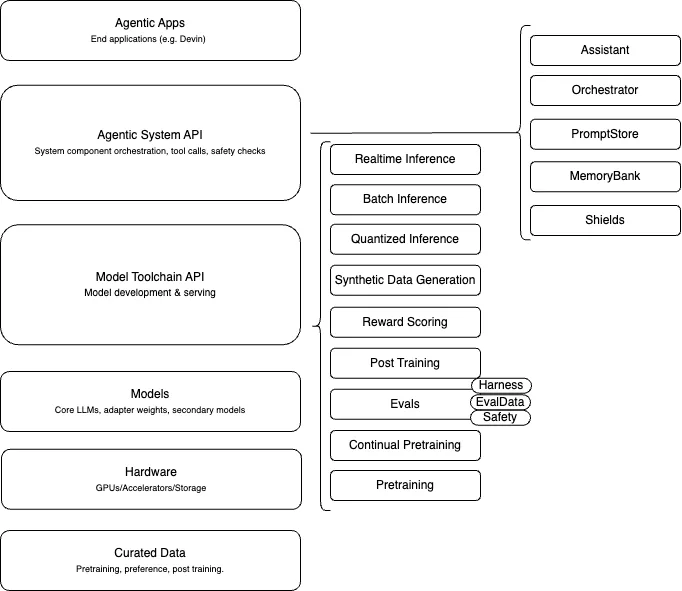
Meta announced Llama Stack at Connect on September 25, 2024, a set of REST APIs plus client SDKs for Python, Node, Swift and Kotlin that cover the same Llama features wherever the model runs. The repository defines APIs for Inference, Safety, Memory, Agentic System, Evaluation, Post Training, Synthetic Data Generation and Reward Scoring, and lists PyTorch ExecuTorch as the on-device provider, covering inference and agents on iOS. The models announced at the same event are covered separately.

Llama Stack separates providers from distributions. A provider is the implementation behind an API, which can be local code or a pointer to a remote service, and a distribution assembles providers behind one endpoint. Meta’s README states that providers can be mixed, that a hobbyist can serve a small model locally and use a cloud provider for a large one, and that the higher level APIs the app works with do not change, including across the server and mobile-device boundary.

Layer diagram stacking curated data, hardware, models, a Model Toolchain API and an Agentic System API under agentic apps, with inference, training, eval and safety endpoints branching off
Diagram: Meta. From the Llama Stack repository documentation.

On iOS the local provider is a Swift class called LocalInference, which the documentation describes as powered by ExecuTorch. It implements the same Inference interface the Swift client uses for remote servers, so an app that already streams chat completions or agent turns keeps its calling code and swaps the service it was given. Developers export the model to an ExecuTorch .pte file, bundle it with tokenizer.model in the app, and link the XNNPACK, Core ML and MPS backends plus the quantized and optimised kernels, with Meta’s own example loading a SpinQuant build of Llama 3.2 1B.

The Swift package is added through Xcode’s package manager and generates its types from the Llama Stack OpenAPI spec, and Meta listed its first release on October 10, 2024. The same iOS documentation stated that on-device inference for Android was coming soon, and pointed developers to ExecuTorch’s own Android demo app in the meantime. Llama Stack, the Swift client and the Kotlin client are published under the MIT license.

Update, December 6, 2024. Meta released version 0.0.54 of the Kotlin client, which adds on-device inference on Android. The README names ExecuTorch as the local inference distributor, has developers run a script that fetches a prebuilt executorch.aar with the XNNPACK delegate into the app’s libs directory, and shows the only difference between the two modes as the client builder, LlamaStackClientLocalClient with a model and tokenizer path against LlamaStackClientOkHttpClient with a base URL. The chatCompletion call that follows is identical.

Meta releases Llama 3.2 1B and 3B for phones and edge devices

Meta released Llama 3.2 on September 25, 2024, including text-only 1B and 3B models built for phones and edge hardware. Both carry a 128K token context window and are aimed at summarisation, instruction following and rewriting that run locally, with the data staying on the device.

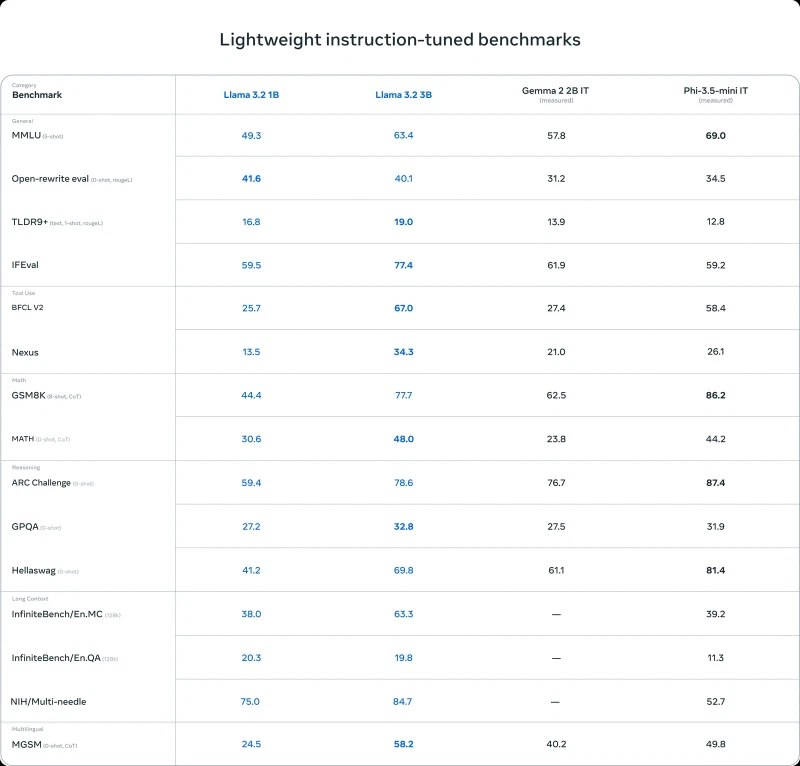
Meta built them by structured pruning from Llama 3.1 8B, then recovered quality through knowledge distillation using logits from the 8B and 70B models during pretraining. The company reports the 3B model ahead of Gemma 2 2.6B and Phi 3.5-mini on instruction following, summarisation, prompt rewriting and tool use, and puts the 1B model on a par with Gemma. In Meta’s own table the 3B model scores 77.4 on IFEval against 61.9 for Gemma 2 2B and 59.2 for Phi-3.5-mini, and 67.0 on BFCL V2 for tool use against 27.4 and 58.4.

Benchmark table comparing Llama 3.2 1B and 3B with Gemma 2 2B IT and Phi-3.5-mini IT across general, tool use, math, reasoning, long context and multilingual tasks
Table: Meta. The company measured the Gemma and Phi results itself.

The models shipped with day-one support for Qualcomm and MediaTek silicon and run on Arm, which Meta says covers 99 percent of mobile devices. Weights are on llama.com and Hugging Face, with deployment paths through PyTorch ExecuTorch for devices and Ollama for single-node setups, and the company lists more than 25 partner platforms at launch.

Saturday 21 September 2024

CoMiGS splits on-device fine-tuning into shared generalists and private specialists

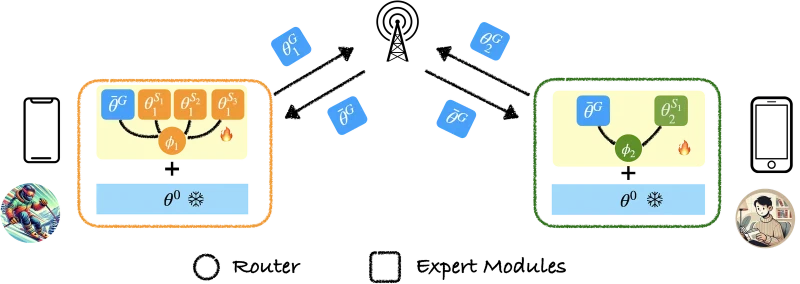
Four researchers at EPFL published CoMiGS on September 20, 2024, a scheme in which many devices fine-tune a language model together, with some of the added model parts shared across everyone and the rest kept on the device that trained them. In a simulation of four users, each holding Wikipedia articles in a different language, the authors measure test perplexity at 47.19 with GPT-2 124M as the base model, against 54.38 when each user trains alone on local data and 58.80 for federated averaging, which pools every user’s update into one shared model. Perplexity measures how surprised a model is by the next token, so lower is better. The paper appeared at ICML 2025.

Nobody retrains the base model. Each device trains small LoRA adapters on top of pretrained weights that stay frozen, and CoMiGS sorts those adapters into two kinds. Generalist adapters are averaged across all devices at every communication round, specialist adapters and a small router never leave the device, and the router decides per token which adapters to use. The authors train that router against a separate validation set rather than the training data, and report that in the first layer of the network common function words such as “and”, “a” and “the” go mostly to the generalists, while for the users trained on maths and programming text the domain-specific terms in the last layer go mostly to the specialists.

Nothing here ran on a phone. The appendix states that every experiment except the centralised baseline ran on a single NVIDIA A100-SXM4-40GB, with four simulated users holding between roughly 400,000 and 1 million training tokens each, drawn from multilingual Wikipedia, SlimPajama, AG News and Common Corpus, and averaged over three seeds. The base models are GPT-2 124M and Llama 3.2 1B. Results in the paper’s table are mixed rather than uniform, with CoMiGS ahead of both baselines on multilingual Wikipedia, SlimPajama and Common Corpus, and behind federated averaging on AG News, at 33.53 against 31.84 with GPT-2 and 16.31 against 15.86 with Llama 3.2 1B, which is the one setup where the test data does not follow the training distribution.

The second set of experiments gives users different numbers of adapters, two to four per device with one of them always a generalist, which is how the method is meant to cope with devices of unequal capacity. Against HetLoRA and FlexLoRA, two methods that vary the LoRA rank per device instead, the authors report lower perplexity on every in-distribution task, for example 18.68 against 21.41 and 24.63 on Common Corpus with Llama 3.2 1B. They put the overhead of their extra router at 1.25 percent more computation per forward pass and 1.25 percent more memory, with communication per round halved against federated averaging because only the generalist weights are sent.

The paper names its own limits. The authors write that differential privacy on the aggregated generalist weights is something they “do not pursue here”, that robustness against attackers is beyond the scope of the work and that their aggregation carries no guarantee against adversarial parties, and that there is a limit to how much the generalists can prevent overfitting when the local task is easy. They also note that fine-tuning Llama 3.2 1B on multilingual Wikipedia or SlimPajama produced negligible improvements, which they attribute to overlap with its pre-training data, and that is why the Llama runs use Common Corpus instead. The code is on GitHub under the Apache 2.0 licence.

Diagram of two users, one with a generalist and three specialist adapter modules feeding a router, the other with a generalist and one specialist, both stacked on frozen base weights, with only the generalist weights travelling out for averaging and back
Diagram: Fan et al., Figure 2 of the paper, licensed CC BY 4.0. The router and the specialists stay on the device.

Sunday 8 September 2024

ElastiLM resizes a shared phone LLM per request and switches in 0.31 seconds

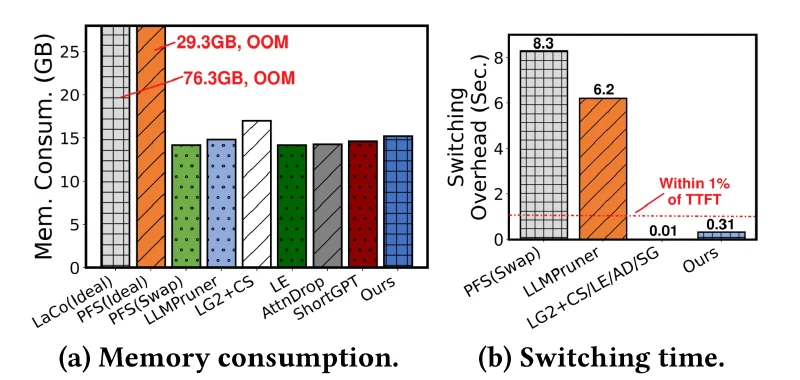
Researchers at Peking University and Beijing University of Posts and Telecommunications published ElastiLM on September 8, 2024, a phone-side language model service that resizes itself for every request. Running LLaMA-7B on a Redmi K60 Champion Edition with a Snapdragon 8 Gen 2, the authors measure 0.31 seconds to switch from one sub-model to another, against 8.3 seconds for swapping in a separately pretrained model of the right size and 6.2 seconds for the pruning method LLMPruner.

The setup the paper assumes is one model held by the operating system that every app calls, the way Android AICore serves apps like Gboard smart reply. Those callers want different things from it, and the authors put an always-on voice assistant that needs an answer almost immediately next to a background screen-event recorder that can wait. ElastiLM takes a latency budget along with each request and then picks how much of the model to run and how much of the prompt to keep, in steps of 10 percent, rather than running one fixed model at one fixed speed.

Accuracy is what pays for the speed. Cutting the prompt drops words the model might have needed and pruning removes whole attention heads and MLP neurons, and the split matters as much as the total, since the authors show one science question that half the prompt with an 80 percent sub-model answers correctly while 80 percent of the prompt with a half-size sub-model gets wrong. Preparing a model costs 68.3 GPU hours on a server with NVIDIA A40s, which the authors price at about $100 of rented time and put at 21.7 to 68.2 hours more than the pruning baselines. The service runs on four big CPU cores, and the authors state that as of August 2024 no mobile GPU or NPU could run ElastiLM or its baselines end to end, so their accelerator figures are projected from profiled latency rather than measured on a device.

Across the Redmi K60 Champion, a Mi 14 and a Redmi K70 Pro, the last two on Snapdragon 8 Gen 3, the authors report ElastiLM answering more requests correctly than seven baselines by 6.60 to 14.83 percent in absolute accuracy, 10.45 percent on average, on traces of 600 requests drawn from six datasets. Peak memory for LLaMA-7B sits at 15 to 17 GB, level with the baselines, while keeping a dedicated model per latency budget would take 29.3 GB or 76.3 GB and runs out of memory on all three phones, which carry 19 GB to 24 GB of RAM. Weight-only quantisation to 8 bits costs almost no accuracy and 4 bits about 3 percent absolute, by the authors’ measurement. The paper appeared at MobiCom 2025 in Hong Kong in November 2025 and is on arXiv under a CC BY 4.0 license.

Two bar charts for LLaMA-7B, peak memory with ElastiLM at about 15 GB among baselines at 14 to 17 GB and two out-of-memory cases at 29.3 and 76.3 GB, and switching time with ElastiLM at 0.31 seconds against 8.3 and 6.2 seconds for the swap and LLMPruner baselines and 0.01 seconds for the layer-level ones
Charts: Yin et al. Online overhead measured on a Redmi K60 Champion Edition, with the dashed line marking 1 percent of average time to first token.

Tuesday 3 September 2024

Ai2 releases OLMoE, 7B parameters with 1B active per token

Ai2 published OLMoE-1B-7B on September 3, 2024, a language model with 6.9B total parameters of which only 1.3B run on any given token. It is a sparse mixture of experts, meaning each layer holds 64 small feedforward networks and a small router picks 8 of them per token, so the rest of the model stays idle. Compute per token lands near that of a dense 1B model, while all 6.9B parameters still have to be held in memory.

Ai2 pretrained the model on 5 trillion tokens and reports in the paper that it leads every open model in its active-parameter class. On MMLU the paper puts OLMoE-1B-7B at 54.1, against 48.5 for DCLM-1B, 33.6 for TinyLlama-1B and 32.1 for Ai2’s own dense OLMo-1B. The paper states the model matches or outperforms the dense OLMo-7B at the end of pretraining while using less than half the training FLOPs, and that it beats Llama2-7B on MMLU, scored at 46.2, despite needing roughly 6 to 7 times less compute per forward pass. The instruction-tuned version is reported above Llama2-13B-Chat and DeepSeekMoE-16B.

For the training-cost claim the authors ran a controlled comparison, training a 1.3B dense model and a 1.3B active, 6.9B total mixture of experts on 128 H100 GPUs for 130B tokens each. Ai2 reports the sparse model reaching the dense model’s final quality with about 3 times fewer tokens and FLOPs, but only about 2 times faster in wall-clock time, because the larger weight set dropped throughput to 23,600 tokens per second per GPU against 37,500 for the dense run. The full pretraining run used 256 H100 GPUs for around 10 days.

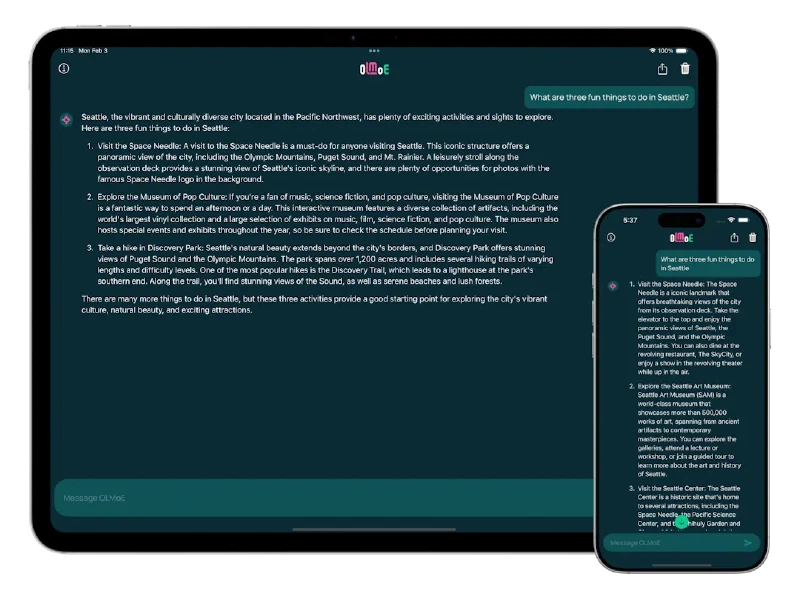
Ai2 shipped an iOS app on February 11, 2025 that keeps the whole model on the device, so prompts and responses never reach a server and generation keeps working in airplane mode. Ai2 names the iPhone 15 Pro and 15 Pro Max, the four iPhone 16 models and M-series iPads going back to the 2021 iPad Pro, and states that the first version needs an iOS device with 8 GB of memory. The app runs a 4-bit quantised build of the January 2025 instruction-tuned model, which Ai2 measures at 41 tokens per second on average on an iPhone 16 Pro, on a stack Ai2 built with GenUI on top of llama.cpp.

Weights, the training data mix, the training code and the run logs are all published under Apache 2.0, together with 244 intermediate checkpoints. The comparison table in the paper lists OLMoE as the only mixture-of-experts release that opens all four, with most of the other models in the table offering a single checkpoint and no logs. The app is in the App Store and its source code is on GitHub.

The OLMoE app on an iPad and an iPhone, both answering the same prompt about things to do in Seattle with a numbered list
Screenshot: Ai2.

Update, April 14, 2025. Ai2 kept working on the app after the February launch and added macOS support on March 7, 2025 through Mac Catalyst, Apple’s compatibility layer that runs the same iOS code natively on a Mac, together with a counter that shows how many tokens a reply used. A later version reworked the panel that reports generation metrics, and the most recent release, from April 14, 2025, renamed the app to Ai2 OLMoE. Nothing has shipped in the repository since.