Prism ML releases Bonsai 2 27B for iPhone, iPad and Mac, with a 3.9 GB 1-bit version
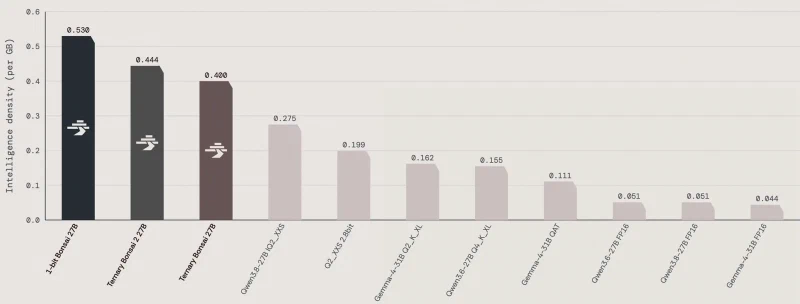
Prism ML has released Bonsai 2 27B, a compressed version of Qwen3.8 27B that runs on Apple devices including iPhone, iPad and Mac via MLX, using custom low-bit kernels. On NVIDIA GPUs it runs via CUDA. For the iPhone 17 Pro, Prism lists a 1-bit version at 3.9 GB with a 262K-token context window.
The main Ternary Bonsai 2 27B model stores each weight as -1, 0 or +1 with FP16 scaling per group of weights. This works out to 1.76 effective bits per weight and a total footprint of 5.9 GB, which Prism says is more than 9x smaller than the full-precision model. The model accepts text and image input.
Prism reports an aggregate benchmark score of 83.9 for the ternary model, compared with 85.4 for Qwen3.8 27B, which it describes as 98.2% retention. The model scores 82.66 in instruction following against 81.25 for the original, and trails it in knowledge and reasoning (83.95 against 86.66), vision (78.59 against 81.64) and agentic tool calling (77.57 against 79.74). Prism also gives 96.57 for math and 81.58 for coding, against 97.06 and 82.17 for Qwen3.8 27B.
According to Prism, the ternary model generates up to 143 tok/s on an NVIDIA GeForce RTX 5090 and 46.8 tok/s on an Apple M5 Max. On an RTX 4090 it uses 0.714 mWh per token, which the company says is 40% less than a full-precision 8B model. The project repository lists peak memory for text-only use at about 7.8 GB at 4K context and 13.7 GB at 100K context, with images adding about 0.9 GB.
The model is released under the Apache 2.0 license. The Hugging Face collection holds GGUF and MLX 2-bit versions, and the repository documents running it with llama.cpp on Macs with Apple silicon and on CUDA, Vulkan, ROCm and CPU. A WebGPU demo runs in the browser on Hugging Face Spaces.