Prism ML releases Bonsai Image 4B, a 1-bit image model that runs on iPhone
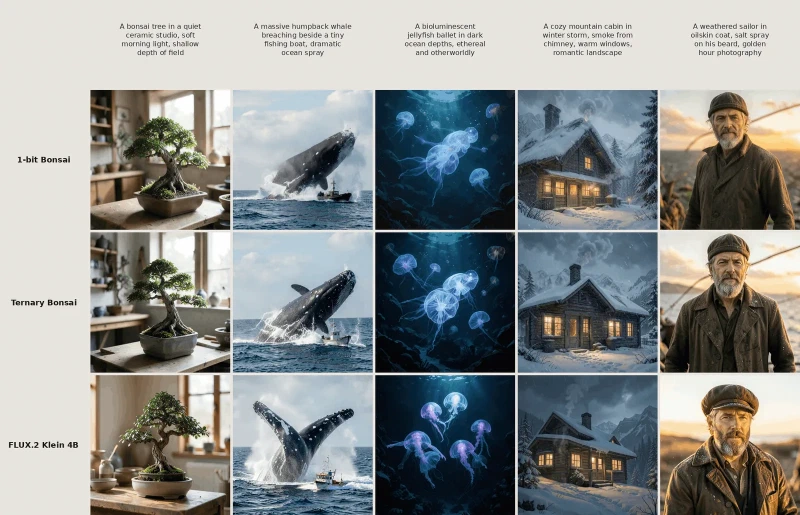
Prism ML has released Bonsai Image 4B, an image generation model with 4 billion parameters in a 1-bit and a ternary version. The company says it is the first image model in its parameter class to run directly on an iPhone. It generates a 512x512 image in 9.4 seconds on an iPhone 17 Pro Max and in about 6 seconds on an M4 Pro Mac, where Prism reports up to 5.6 times the speed of the stock full-precision MFLUX pipeline.

Sample images from the Bonsai Image 4B announcement.Prism ML
The diffusion transformer takes 0.93 GB in the 1-bit version, which uses 1.125 effective bits per weight, and 1.21 GB in the ternary version at 1.71 bits. Prism lists 7.75 GB for the comparison model FLUX.2 Klein 4B. The full deployment payload on Apple Silicon is 3.42 GB and 3.88 GB, against 15.97 GB for FLUX.2 Klein 4B. At runtime, 512x512 generation uses 1.5 GB and 1.96 GB against 11.74 GB, and 1024x1024 generation uses 1.95 GB and 2.38 GB against 14.39 GB.
Prism scores the ternary version at 0.723 on GenEval, 12.22 on HPSv3 and 0.851 on DPG-Bench, which it summarizes as 95% of FLUX.2 Klein 4B overall. The 1-bit version scores 0.671, 11.15 and 0.822, or 88%, while FLUX.2 Klein 4B scores 0.819, 12.84 and 0.853. GenEval measures object composition and attribute binding, HPSv3 human preference and DPG-Bench how well dense prompts are followed.
The models run on iPhone, iPad and Mac via MLX low-bit paths and on CUDA GPUs via Gemlite low-bit kernels. They are released as open weights and code under the Apache 2.0 license, and Prism ships the iOS app Bonsai Studio for trying the model on iPhone. Weights are in the Hugging Face collection, code is in the GitHub repository, and a WebGPU demo runs in the browser.