Google releases EmbeddingGemma 2, a 740M multimodal embedding model for edge devices
Google DeepMind has released EmbeddingGemma 2, an open-weight embedding model with 740 million parameters that maps text, images, video frames and audio into a single vector space. The Google AI Edge team reports that the text-only weights run in about 191 MB of active RAM on a Pixel 11 Pro, and the full multimodal model in about 567 MB.
The model splits into encoders that load separately, a 270M-parameter text core plus a 170M vision encoder and a 300M audio encoder, so an app can activate audio only when voice memos appear. Quantization-aware training compresses the weights to 4-bit and 8-bit, with mixed 2-bit, 4-bit and 8-bit channels in the audio encoder, which puts the LiteRT download at 165 MB for text alone, 388 MB with vision and 485 MB for all three modalities. Context runs to 8,192 tokens, four times that of EmbeddingGemma 1, and holds up to 5.5 minutes of audio, 29 images or 58 video frames in one pass.
Vision embedding takes 37.3 ms per image on the GPU of a MacBook Pro M5, or 26.9 images per second. The same work takes 69.8 ms on an iPhone 18 Pro GPU, 48.9 ms on the NPU of a Pixel 11 Pro XL and 1,761 ms on a Raspberry Pi 5 CPU, while text-only embedding drops to 8.3 ms on the Pixel’s TPU and 13.6 ms on the NPU of an Arduino Ventuno Q, according to the LiteRT model card. On MTEB Code, a retrieval benchmark for source code, Google reports 78.68 against 68.76 for the first EmbeddingGemma.
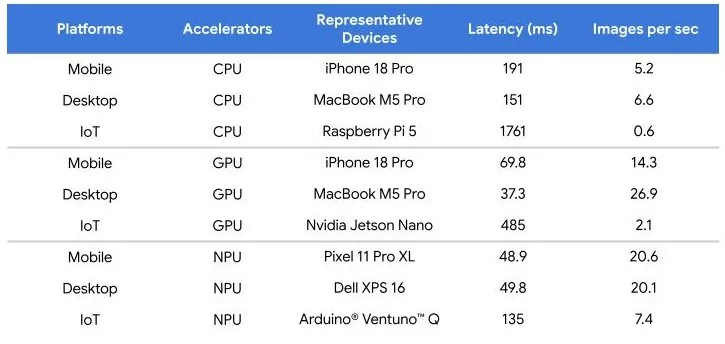
Each device was measured with a maximum budget of 70 vision tokens per image.Google
A single .litertlm file runs on both CPU and GPU across Android, iOS, macOS, Windows, Linux, the web and IoT targets. The MediaPipe Universal Embedder returns normalized vectors of 768 dimensions, which Matryoshka slicing truncates to 512, 256 or 128 to shrink the local index, a saving Google puts at up to 6x. A Semantic Retriever task handles approximate nearest-neighbor search and returns ranked matches in single-digit milliseconds, and a Decision task scores 500 options per turn in under 100 ms in a chess demo. The model is to reach Android as an ML Kit service with NPU acceleration in the coming weeks.
The weights sit on Hugging Face and Kaggle under the Apache 2.0 license, with LiteRT builds under litert-community that include chip-specific files for Google Tensor, Qualcomm, MediaTek and Intel NPUs. Other routes are GGUF for llama.cpp, Ollama, MLX, vLLM and a Transformers.js demo on WebGPU. The Google AI Edge Gallery app for Android and iOS adds two showcases, Instant Media Search and Video Moments Finder, the second of which locates moments in local video without transcribing audio or generating captions. Foresight, an experimental Mac app, pairs the model with Gemma 4 for note-taking during meetings.
This video could not be loaded. Use the link below to open it directly.