ExecuTorch 1.0 reaches general availability for on-device PyTorch models
The PyTorch team released ExecuTorch 1.0 on October 22, 2025, the generally available version of its runtime for PyTorch models on phones, laptops and embedded devices. It takes a model straight from PyTorch without converting it to ONNX or TFLite and without rewriting it in another language, which the team says removes a common source of numerical mismatches and lost debug information. The beta arrived in October 2024.
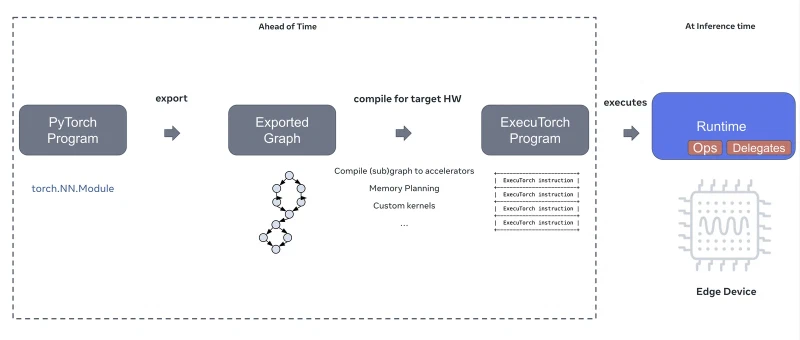
Five backends moved from beta to production status. XNNPACK with Arm Kleidi covers CPU, Apple Core ML covers Apple silicon, the Qualcomm AI Engine delegate covers the Hexagon NPU, and Arm Ethos-U and Vulkan cover NPU and GPU. New backends arrived for Arm VGF, the NXP eIQ Neutron NPU, Samsung Exynos NPU and GPU, and Intel OpenVINO.
Meta says features built on ExecuTorch already run on Instagram, WhatsApp, Messenger and Facebook. Anuj Kumar, Director at Reality Labs, describes what it drives in Meta’s wearables, including the Ray-Ban Display glasses with EMG band.
Advanced AI features like speech recognition, motion sensing, and computer vision run on these devices by leveraging cutting-edge hardware.
Lysandre Debut, Chief Open-Source Officer at Hugging Face, says more than 80 percent of the most downloaded edge-friendly language models on Hugging Face run on ExecuTorch out of the box. The team validated coverage across object detection, depth, OCR, speech recognition and segmentation as well as text and multimodal models such as Voxtral for audio and Gemma 3 for image and text input. The main branch also allows embedding ExecuTorch into native C++ desktop applications.