llm.npu prefills 1,106 tok/s for Qwen1.5-1.8B on a Snapdragon 8 Gen 3
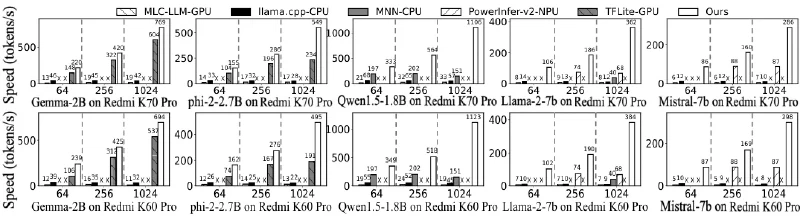
Researchers at Peking University and the Beijing University of Posts and Telecommunications published llm.npu on July 8, 2024, an inference engine that runs the prefill stage of a language model on a phone’s NPU. They tested it on a Redmi K70 Pro with a Snapdragon 8 Gen 3 and a Redmi K60 Pro with a Snapdragon 8 Gen 2, using Qwen1.5-1.8B, Gemma-2B, Phi-2 2.7B, LLaMA2-7B and Mistral-7B. On 1024-token prompts on the K70 Pro the authors report prefill 7.3x to 38.4x faster than the CPU engines MNN and llama.cpp and 1.27x to 43.6x faster than the GPU engines TFLite and MLC-LLM, and for Qwen1.5-1.8B they measure 1,106 tok/s against 151 tok/s for MNN on the CPU and 57 tok/s for llama.cpp on the CPU. Energy was measured on the K60 Pro, the only device they could root, where prefill used 1.85x to 59.5x less energy than the same baselines.
Prefill is the stage where the model reads the whole prompt before it writes its first token, and the paper puts it at 88.3% to 98.8% of total latency on a mobile CPU for UI automation, chat summaries and context-aware generation, and at 54.2% to 91.7% on a mobile GPU. A mobile NPU is fast at integer matrix multiplication but expects fixed tensor shapes, while prompts arrive at any length, so every new length means rebuilding the graph. Quantised activations also contain outliers, single values far outside the usual range, and the accurate remedy is per-group quantisation, which mobile NPUs cannot execute directly and which the authors measure at up to 10.7x overhead when it is split into sub-tensor multiplications.
llm.npu answers both by cutting a prompt into fixed 256-token chunks that run on pre-built graphs, sharing the operators that do not depend on prompt length so the memory cost drops by up to 4x, pulling the outlier values out to the CPU or GPU to run in parallel, and scheduling transformer blocks across the processors out of order. Accuracy stays within 1% of FP16 on LAMBADA, HellaSwag, WinoGrande, OpenBookQA and MMLU. Across three application workloads, UI automation, context-aware email replies and chat summaries, the authors measure end-to-end latency 1.4x to 32.8x lower than the baselines, with decoding still running unoptimised on the CPU.
The system is built on the group’s own mllm inference framework and Qualcomm’s QNN SDK, in about 10,000 lines of C, C++ and assembly, and the code is public in the mllm repository under an MIT license. The paper appeared at ASPLOS 2025 in Rotterdam in spring 2025. PowerInfer-v2, the one comparison system that also uses the NPU for prefill, is not open source, so the authors took its figures from its paper and report a 3.28x to 5.6x speedup over it.