Gemma 3n runs 5B and 8B models in 2 GB and 3 GB of memory
Google previewed Gemma 3n on May 20, 2025, a model built for phones, tablets and laptops. Its 5B and 8B versions run with dynamic memory footprints of 2 GB and 3 GB, which Google says matches what 2B and 4B models normally need.
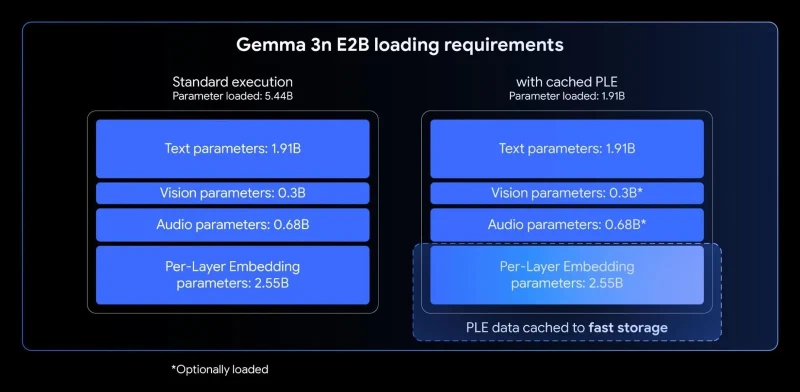
The saving comes from Per-Layer Embeddings, a Google DeepMind technique that keeps embedding parameters off the accelerator. For E2B that cuts what has to be loaded into accelerator memory from 5.44B parameters to 1.91B, with the 2.55B embedding parameters cached to fast storage instead. A MatFormer setup nests a smaller but fully functional 2B model inside the 4B one, so developers can trade quality against footprint. Google reports the model starting to respond about 1.5 times faster on mobile than Gemma 3 4B.
Gemma 3n takes audio, text, images and video as input, including interleaved inputs across modalities, and handles speech recognition and translation. Google states that the same architecture powers the next generation of Gemini Nano, which was to reach Android and Chrome later in 2025. Qualcomm Technologies, MediaTek and Samsung System LSI worked on the optimisation.
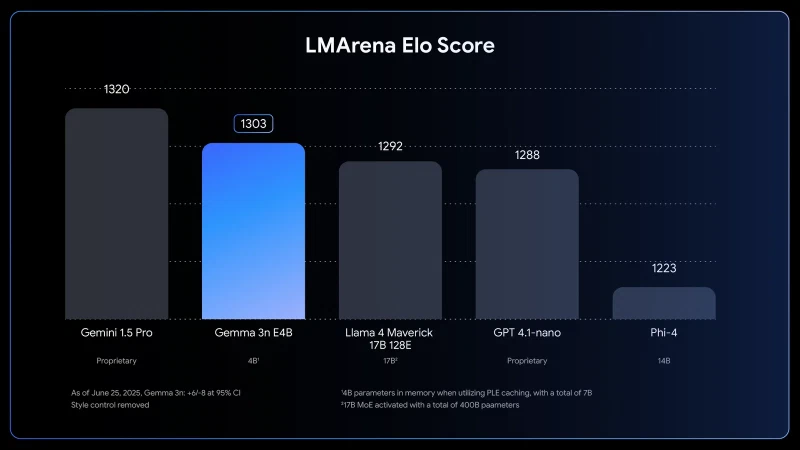
Update, June 26, 2025. Google released Gemma 3n as E2B and E4B, naming them for 2B and 4B effective parameters out of 5B and 8B raw ones. Google reports E4B scoring 1303 on LMArena and calls it the first model under 10 billion parameters to pass 1300, ahead of Llama 4 Maverick 17B 128E at 1292 and GPT 4.1-nano at 1288. The release adds a MobileNet-V5-300M vision encoder, which Google says handles up to 60 frames per second on a Pixel, and KV cache sharing that doubles prefill performance. Text covers 140 languages, multimodal understanding 35. Weights are on Hugging Face and Kaggle, with support in Ollama, llama.cpp, MLX, LiteRT and the Google AI Edge Gallery.