Google AI Edge Gallery runs Gemma 3 1B and Qwen2.5 offline on Android
Google’s AI Edge team has published Google AI Edge Gallery, an app that runs generative models entirely on the device. The home screen offers three tasks, AI Chat for multi-turn conversation, Ask Image for questions about a photo from the camera or the gallery, and Prompt Lab for single-turn work, which covers free-form prompts, rewriting text in a chosen tone, summarising and generating code. Once a model file is on the phone, the app needs no connection and Google states that all processing happens on the device.
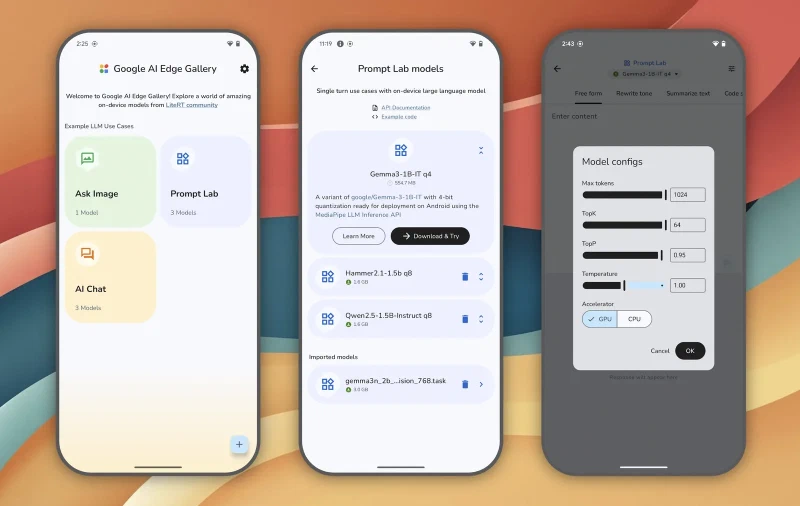
Models come from the LiteRT Community organisation on Hugging Face, which the app’s welcome text links to directly. The first release listed three downloads, Gemma 3 1B IT at 4-bit in 554.7 MB, Hammer 2.1 1.5B at 8-bit and Qwen2.5 1.5B Instruct at 8-bit, the latter two at roughly 1.6 GB each. Gated repositories ask for a Hugging Face access token, which the settings dialog stores and can clear again.
Anything outside that list has to arrive as a LiteRT .task bundle picked from device storage, and the app tells the user that no other file type is supported. Each model then carries a settings dialog with an accelerator switch between GPU and CPU, next to max tokens, top-k, top-p and temperature. The shipped list sets a different default per model, GPU first for Gemma 3 1B and CPU only for Qwen2.5 1.5B Instruct.
After every reply the app prints four of its own measurements, time to first token in seconds, prefill speed and decode speed in tokens per second, and total latency in seconds. It derives them from the session itself, dividing the prompt’s token count by the time the first token took and counting decoded tokens against the clock that starts with that first token, so the numbers describe whatever hardware the app happens to be running on.
Google calls this an “experimental Alpha release” and ships it under the Apache 2.0 licence. There is no store listing at this point, so installing means taking the APK from the project’s releases page on a device running Android 8.0 or newer, with a project wiki covering the corporate-device case. The README lists Android as available now and iOS as coming soon. Underneath, the app builds on LiteRT and Google’s MediaPipe LLM inference API for Android.