Tencent open-sources a 440 MB offline translation model for phones
Tencent Hunyuan has open-sourced Hy-MT1.5-1.8B-1.25bit, a translation model that runs fully offline on a phone. Quantisation to 1.25 bits cuts the file from 3.3 GB at FP16 to 440 MB; a 2-bit build is 574 MB. The announcement states the result is 25 percent smaller and around 10 percent faster than prior 1.67-bit approaches with no loss of accuracy.
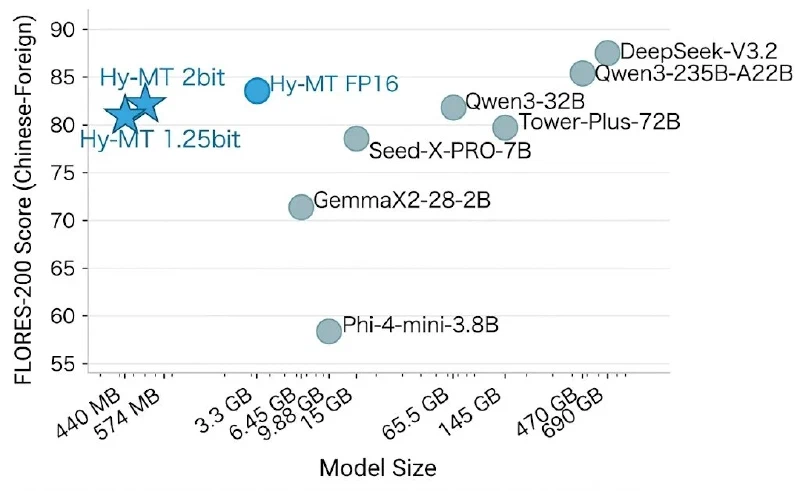
The compression uses Sherry, a ternary quantisation framework with 3:4 fine-grained sparsity: of every four weights, the three most important are stored in 1 bit as -1 or +1 and the fourth is zeroed. A custom STQ kernel aligns the format to the SIMD instruction set of mobile CPUs. Running it requires llama.cpp with STQ1_0 kernel support, added in pull request 22836, and the model card links a side-by-side speed demo recorded on a Snapdragon 888 with 8 GB of RAM.
The model covers 33 languages, 5 dialects and minority languages, and 1,056 translation directions, including Tibetan and Mongolian. On the FLORES-200 benchmark Tencent reports it ahead of Tower-Plus-72B, Qwen3-32B, Microsoft Translator and Doubao on Chinese-to-foreign pairs, and the announcement claims it outperforms Google Translate and matches 235B-scale models.
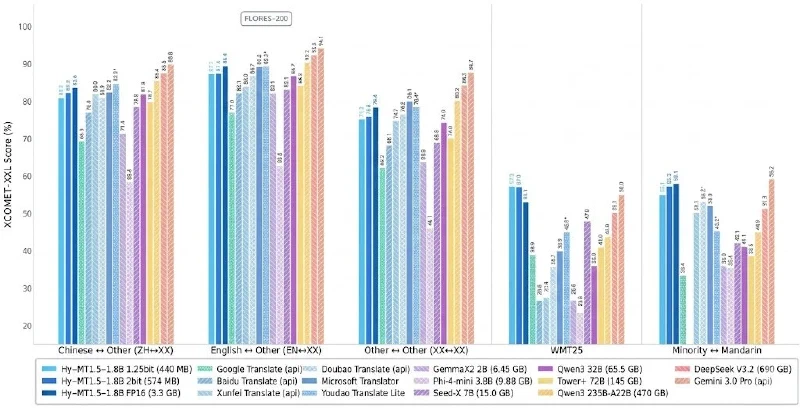
Weights are on Hugging Face alongside an Android demo APK for offline translation. The code is released under the AngelSlim licence rather than a standard open-source licence.