Intelligence per watt puts local model coverage at 88.7% of real queries
Researchers at Stanford University and Together AI profiled more than 20 local models on 1M real queries and report that at least one model with 20B or fewer active parameters answered 88.7% of them correctly. The best single model in their set, GPT-OSS-120B, reached 71.4% on its own, averaged across the four query collections. Their 2025 efficiency figure comes from that model running on an Apple M4 Max.
The paper proposes intelligence per watt, mean task accuracy divided by the mean power the accelerator draws while answering, so a pairing that gets more answers right on the same power budget scores higher. The best local pairing each year moved from 7.92×10⁻⁴ accuracy per watt for Mixtral 8x7B on an NVIDIA Quadro RTX 6000 in 2023, to 1.80×10⁻³ for Llama 3.1 8B on an RTX 6000 Ada in 2024, to 4.18×10⁻³ for GPT-OSS-120B on an Apple M4 Max in 2025, which the authors put at a 5.3 times gain over two years. Query coverage for that single best pairing rose from 23.2% to 71.3% across the same three years. A companion metric divides accuracy by the energy a query consumes instead, so slow generation counts against a device.
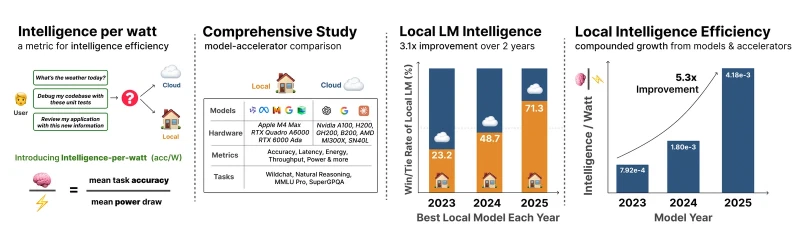
The 1M queries come from four collections. The team took 500K prompts from WildChat, a month of real ChatGPT traffic, 500K from NaturalReasoning, 12K from MMLU Pro and 26.5K from SuperGPQA, all single-turn. WildChat has no ground truth, so GPT-4o judged whether a local model’s answer matched one written by Qwen3-235B, while the other three collections supplied reference answers. Every run used a batch size of 1, one query at a time.
The hardware the authors call local is desktop and workstation class rather than mobile. Their 2025 numbers ran on an Apple Mac Studio with an M4 Max, 128 GB of unified memory and 480 W of continuous power, and the 2023 and 2024 points used NVIDIA workstation cards. No phone, tablet or wearable was profiled. Running the same Qwen3 models, the M4 Max reached 1.40 times lower accuracy per watt than an NVIDIA B200 and 1.6 to 2.3 times lower accuracy per joule, a gap the authors read as headroom for local accelerator design.
For the savings case the team simulated 80.2M queries over 24 hours split between four small models on M4 Max machines and Qwen3-235B in the cloud. Perfect routing to the smallest capable model cut energy by 80.4% against sending everything to the frontier model, and a router that picks correctly 80% of the time cut it by 64.3%, with the perfect case described as a theoretical maximum. The authors note that coverage falls in technical domains such as architecture and engineering, that GPT-OSS-120B answered 88.9% of WildChat queries against 64.9% of NaturalReasoning ones, and that they release their profiling harness so the measurements can be repeated on new hardware.