Liquid AI releases a DSpark drafter that speeds up LFM2.5-VL-3B decoding
Liquid AI has released an experimental DSpark draft model for LFM2.5-VL-3B, its 3-billion-parameter vision-language model. The drafter adds 279.5M parameters, an 8.9% increase over the deployed model. In exchange, the company reports decoding throughput gains of up to 3.13x on edge devices and up to 2.66x on GPUs, with end-to-end gains of up to 2.62x and 2.27x.
On an Apple M5 Max MacBook Pro running MLX-VLM, decoding ran 2.30x to 3.13x faster across six vision tasks, with end-to-end latency improving 1.56x to 2.62x. The same tasks on an M3 Ultra with llama.cpp gave 1.57x to 2.14x faster decoding and 1.30x to 1.77x end to end, while an NVIDIA H100 80GB with SGLang reached 2.04x to 2.66x. Liquid AI measured all of it at batch size 1 and reports that the drafter’s guesses were accepted at a rate of 3.2 to 4.57 tokens per verification pass.
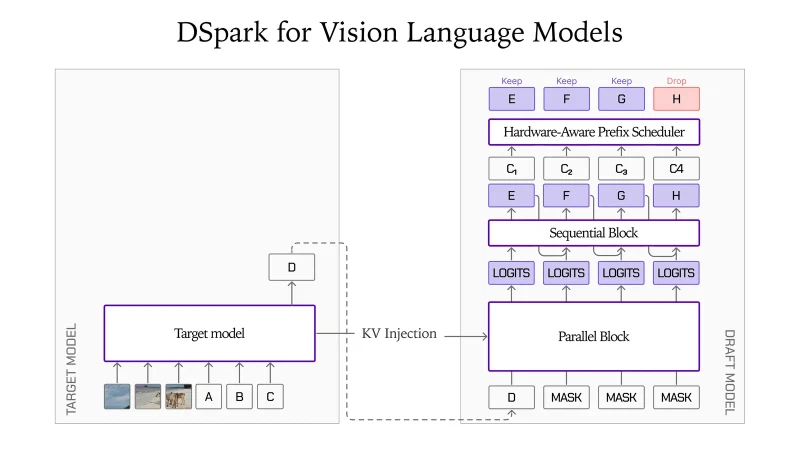
Speculative decoding lets a small model guess the next few tokens, which the full model then checks in a single pass and accepts or rejects, so the output does not change. DSpark takes hidden states from different layers of the target model and feeds them to the drafter, a 4-layer decoder stack of 193.0M parameters combined with a 65.5M-parameter Markov head, a hidden-state projection and a confidence head. The design carries over from text to vision without modification, Liquid AI says, because image patches and text are both multi-dimensional tensors by the time they reach the hidden layers, which makes the input modality irrelevant to the drafter.
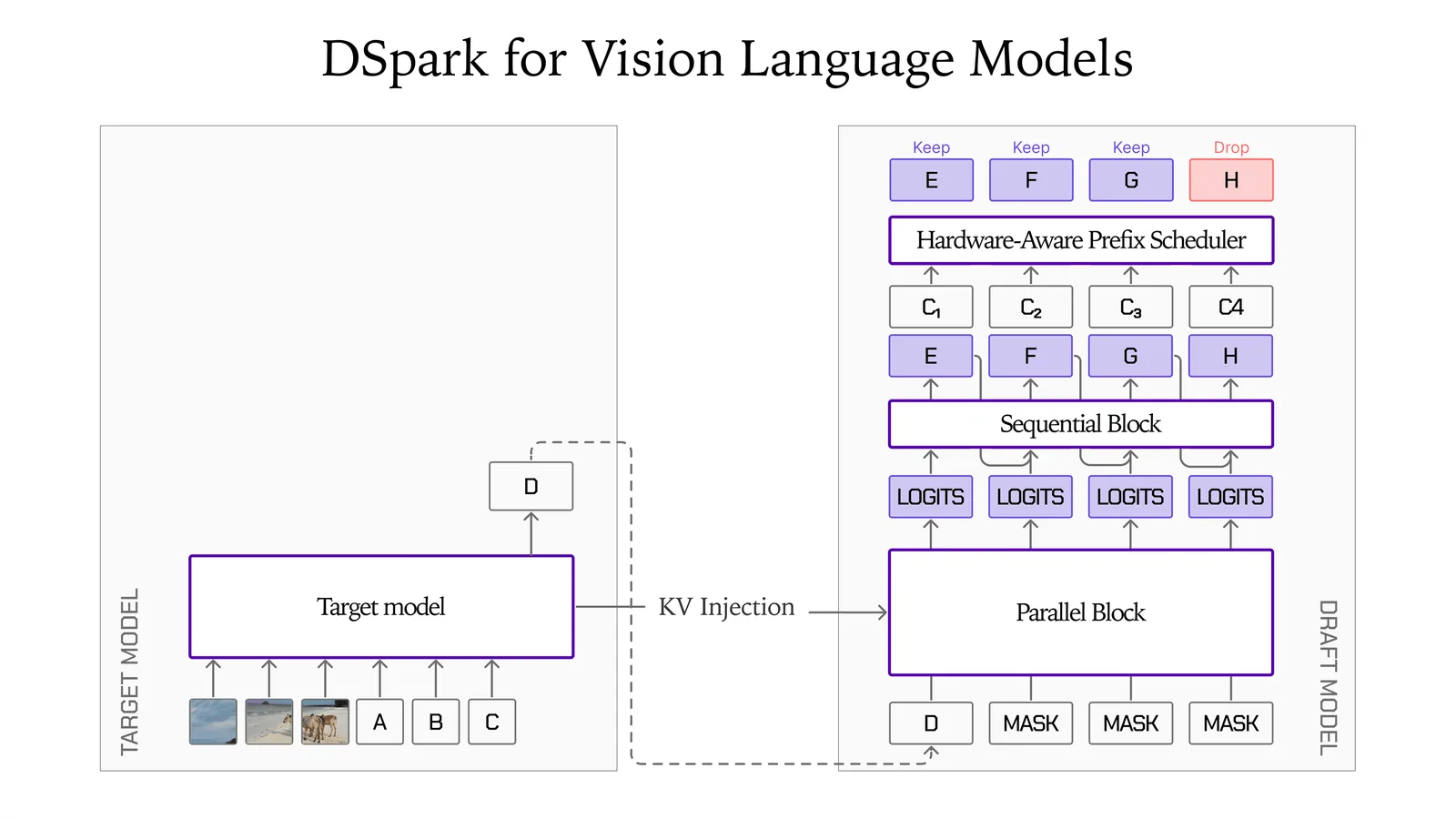
The drafter receives the target model’s key-value cache and proposes a block of tokens that a hardware-aware prefix scheduler then keeps or drops.Liquid AI
Gains on edge hardware stay below the raw decoding figures for a reason the company names itself. Vision encoding and prefill account for a larger share of end-to-end latency there, and speculative decoding only accelerates the decode phase. Acceleration of quantized models falls outside the scope of this release, and acceptance rates drop at higher temperatures, because probability mass spreads to lower-ranked candidate tokens where drafter and target are more likely to disagree.
The weights are on Hugging Face in Safetensors and as a separate GGUF checkpoint, under Liquid AI’s LFM1.0 license, which the company describes as open-weight and free to download, fine-tune and deploy. Support ships with the release through pull requests to llama.cpp, SGLang and MLX-VLM, and the model card asks for SGLang 0.5.19 or newer on NVIDIA GPUs and MLX-VLM 0.7.2 or newer on Apple silicon. The drafter works only with the LFM2.5-VL-3B target model, at a recommended block size of 9 on NVIDIA hardware and 8 on Apple silicon.