LLMFarm runs llama.cpp models offline on iOS and macOS
Artem Savkin published the first release of LLMFarm on June 14, 2023, an iOS and macOS app that loads a quantised model file kept on the device and holds a chat with it offline. The app is built on ggml and llama.cpp, and the README asks for iOS 16 or later and macOS 13 or later.
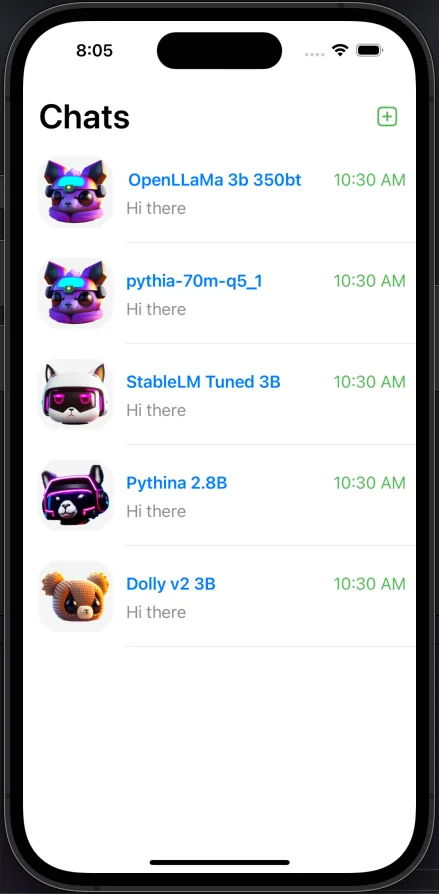
The app reads two llama.cpp file formats, the older ggjtv3 files with a .bin extension and GGUF files, according to the project FAQ. The first release covered LLaMA, GPT-NeoX and GPT-2 style models, with 3B builds of OpenLLaMa, StableLM and Dolly v2 among those it listed as working on an iPhone. The README has since added Gemma, Phi, Qwen, Mixtral, RWKV and LLaVA-style vision models, and marks most of them as running through Metal, Apple’s GPU interface, which it says does not work on Intel Macs.
Quantisation happens before a model reaches the phone, and the project’s on-device notes list 7B Llama 2 and Orca builds at 3-bit and 4-bit as the ones tried on an iPhone 12 Pro Max, with no published token rates. Each chat writes a JSON file of inference options, which the first release documented with defaults of temperature 0.8, top-k 40, top-p 0.95, a 2048-token context and a repeat penalty of 1.1. The app also offers tail free sampling, locally typical sampling, Mirostat, greedy decoding and grammar-constrained output. Models arrive either through an add model button that imports a file from local storage or through a download list inside the app, and the sandboxed app keeps them in its own models directory.
Memory sets the ceiling on an iPhone. The first release’s model table marked 3B models as working on an iPhone 12 Pro Max and 7B and 13B models as returning a “bad alloc” error, and the README said extended memory might be needed to solve it. The FAQ states that the Extended Virtual Addressing and increased-memory-limit entitlements are required to run models larger than 3B, and that the most common reason for a crash is lack of memory. LLMFarm is published under the MIT license, and the README now says the app is temporarily unavailable in TestFlight and the App Store.