llada.cpp runs a diffusion LLM on a Snapdragon NPU up to 42 times faster
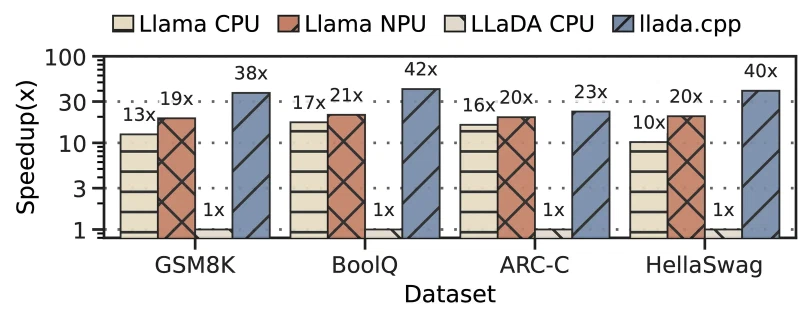
Tuowei Wang, Yanfan Sun and Ju Ren of Tsinghua University and Beihang University published llada.cpp on June 11, 2026, an inference framework that runs diffusion language models on a phone’s NPU. On an OnePlus Ace5 Pro with a Snapdragon 8 Elite, the authors measure LLaDA-8B-Instruct generating 128 tokens 38 times faster than the same model on the phone’s CPU for GSM8K prompts and 42 times faster on BoolQ, and they report a range of 17 times to 42 times across their phones and tasks. The same figure puts Llama-3-8B-Instruct on the NPU at 19 to 21 times that CPU baseline, and the authors state that llada.cpp runs LLaDA-8B up to 3.9 times faster than an autoregressive model of the same size.
A diffusion language model does not emit one token after another. It starts from a block of masked positions, 32 tokens by default here, and refines all of them together over repeated denoising steps, committing the positions it is most confident about and carrying the rest into the next step. That turns decoding into a run of large matrix operations, which is the work a mobile NPU is built for, while autoregressive decoding hands the NPU one token’s worth of work per step. The cost the paper identifies is that every denoising step recomputes the full sequence, so the parallel work gets repeated many times over.
llada.cpp is built on llama.cpp and targets Qualcomm’s Hexagon NPU with 4-bit weights. Once a block is nearly done only a few masked tokens are left, so the framework pulls tokens from the next block into the same NPU pass to keep it full, keeps already committed tokens open to revision and repairs the unstable ones on the CPU while the NPU carries on, and repacks the limited address space the NPU can see so weights and cache do not have to be remapped between steps. The authors’ breakdown of a 128-token GSM8K request on the Snapdragon 8 Elite puts it at 2996.2 s on the CPU, 607.0 s once the prefix KV cache is reused, and 16.1 s with the full framework.
Accuracy moves in both directions. Measured on 200-sample subsets against LLaDA-8B-Instruct on the CPU, the authors’ table has GSM8K rising from 39.0 to 43.5 and ARC-C from 84.0 to 85.0, while BoolQ falls from 82.5 to 80.5 and HellaSwag from 51.0 to 49.5, and their ablation shows the borrowed future-block tokens costing accuracy on all four tasks before the CPU-side revision path recovers it. The work covers three 16 GB phones, an OnePlus 12 with a Snapdragon 8 Gen 3, the Ace5 Pro, and an OnePlus 15 with a Snapdragon 8 Elite Gen 5, and the authors state that on the Snapdragon 8 Gen 3 their framework is still slower than Llama-3-8B at 128 tokens and only pulls ahead on the two newer chips. The paper is on arXiv under CC BY 4.0 and names no code release.