OpenMobile-2 reaches 79.9 on AndroidWorld, with 9B and 27B weights now public
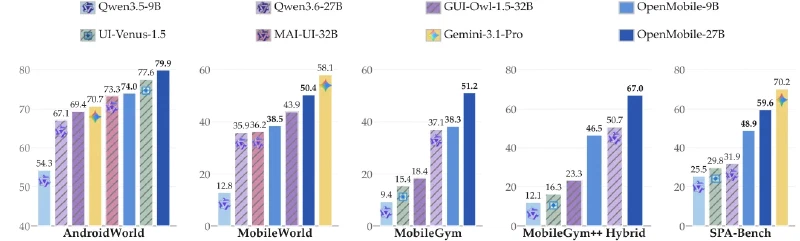
OpenMobile-2 is a pair of open mobile agent models, at 9B and 27B parameters, that operate Android apps from screenshots. The larger checkpoint reaches 79.9 on AndroidWorld and 59.6 on SPA-Bench L3, a benchmark that runs tasks on physical Android phones, up from 31.9 for the Qwen3.6-27B model it was trained from, according to the paper by a team at Nanjing University, the National University of Singapore, SenseTime and three other institutions. The 9B version reaches 74.0 on AndroidWorld.
The paper does not say where the models run during the real-device tests, and it names no phone, chip or NPU. The authors describe SPA-Bench L3 only as an evaluation setting that goes beyond their emulators and simulators, and the one inference stack they document is a server-side vLLM engine used for reinforcement learning on 32 H800 GPUs. On the same real-device benchmark, Gemini-3.1-Pro stays ahead at 70.2 in the authors’ own reproduction.
MobileGym++ supplies the training ground, a set of 35 commercial-style apps built to stay controllable for reset and verification, which together with configured Android emulators covers more than 110 apps. A second line of work exposes selected app functions as callable tools next to the normal interface, more than 300 of them across over 50 apps, so an agent can mix taps and tool calls inside one task. Tool access raised task success by 5.6 points for the 9B model and 10.3 points for the 27B model and shortened trajectories by about five steps, though the authors report that models rarely learn when to invoke a tool unless tool use is part of training.
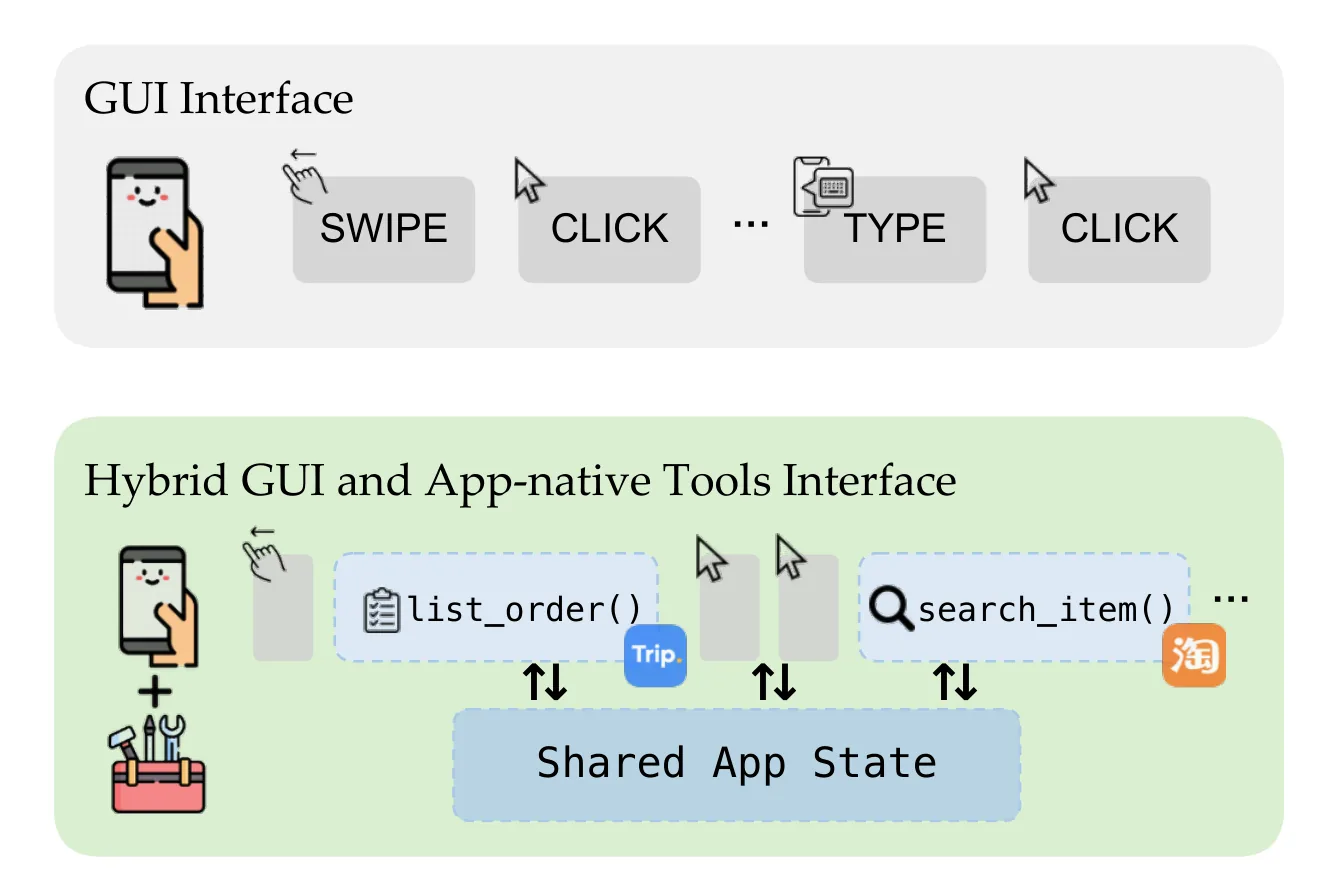
The hybrid setting lets an agent call app-native functions in the middle of a GUI trajectory.OpenMobile-2
Training data covers 11.6K interaction trajectories and more than 2,000 executable tasks with automatic rewards, published as a dataset on Hugging Face next to checkpoints for both model sizes. The code sits on GitHub under Apache 2.0, with the repository noting that third-party models, datasets and benchmark code keep their own licenses, and the MobileGym++ environment ships separate data terms. A project page collects the releases together with MobileGym++ Bench, 215 tasks that span up to four apps. The team cautions that gains from reinforcement learning depend on how closely the training environment matches the evaluation scenario.