Microsoft carries its textbook data recipe from code to reasoning with the 1.3B phi-1.5
Microsoft Research published phi-1.5 on September 11, 2023, a 1.3-billion-parameter model that applies the synthetic textbook data approach of phi-1 to common sense reasoning and general world knowledge rather than Python code. The authors report common sense benchmark results comparable to models ten times the size trained on more than ten times as much data, and describe natural language performance as comparable to models five times larger.
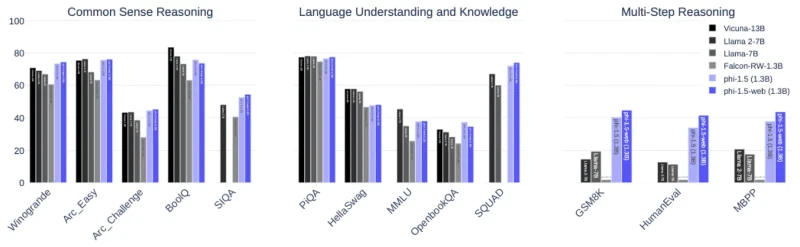
phi-1.5 scores 0.734 on WinoGrande against 0.691 for Llama2-7B, 0.444 on ARC-Challenge against 0.434, and 0.526 on SIQA against 0.480, all measured in Microsoft’s own evaluation pipeline. The gap widens on multi-step reasoning, with 40.2 on GSM8K grade-school maths against 14.6 for Llama2-7B, 34.1 on HumanEval against 12.8, and 37.7 on MBPP against 20.8, which the authors note puts its coding scores at or above Llama-65B. MMLU runs the other way, at 0.376 for phi-1.5 and 0.453 for Llama2-7B.
The training set combines 7B tokens from phi-1 with roughly 20B tokens of newly generated textbook-like text, seeded from 20,000 selected topics spanning science, daily activities and theory of mind. That yields a 30B-token dataset whose only non-synthetic part is 6B tokens of filtered code, and training runs over 150B tokens, 80 percent of them from the new synthetic data. Microsoft puts the cost at 1,500 GPU hours on a single A100-80G, against more than 80,000 hours for Llama-7B.
The same report covers two variants built to test what web data adds. phi-1.5-web-only trains purely on 95B tokens of filtered web text, 88B of it from the Falcon RefinedWeb dataset and 7B of code from The Stack and Stack Overflow, while phi-1.5-web mixes filtered web data, phi-1’s code and the synthetic text in shares of roughly 40, 20 and 40 percent. phi-1.5-web comes out ahead on reasoning at 44.6 on GSM8K, 41.4 on HumanEval and 43.5 on MBPP.
The authors list hallucinations and the potential for toxic and biased generations among the traits phi-1.5 shares with larger models, and write that it “is not immune” despite the absence of web data in its training set. On an 86-prompt probe they wrote themselves, phi-1.5 passed 47 and failed 34, while Llama2-7B and Falcon-7B failed 54 and 50. Microsoft released the raw base model with no instruction fine-tuning and no RLHF, and the weights sit on Hugging Face under the MIT license.