Microsoft releases Phi-2, a 2.7B model it says matches models 25 times larger
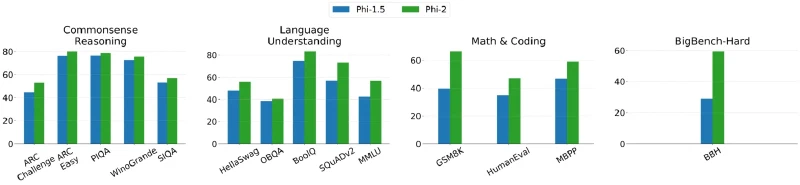
Microsoft released Phi-2 on December 12, 2023, a base language model with 2.7 billion parameters. The company says that on complex benchmarks it matches or outperforms models up to 25 times larger, and that it surpasses Mistral and Llama-2 at 7B and 13B parameters on various aggregated benchmarks. Microsoft’s own table scores Phi-2 at 53.7 on grouped coding benchmarks against 38.3 for Llama-2-70B, and at 61.1 on math against 64.1 for the same model. Against Google’s Gemini Nano 2 at 3.2B, Microsoft reports 59.3 versus 42.4 on BigBench-Hard and 59.1 versus 27.2 on MBPP, using Google’s own reported figures for the comparison.
Microsoft trained the model on 1.4 trillion tokens from multiple passes over a mixture of synthetic and web data for language and code, following what it calls textbook-quality data. The synthetic sets were written to teach common sense reasoning and general knowledge such as science, daily activities and theory of mind, and the web portion was filtered for educational value and content quality. The model card puts the underlying dataset at 250 billion tokens, combining synthetic text generated with GPT-3.5 and web data from Falcon RefinedWeb and SlimPajama that was assessed with GPT-4.
Microsoft did not train Phi-2 from scratch. It started from the 1.3-billion-parameter Phi-1.5 and embedded that model’s knowledge inside the larger one, a step the company says both accelerates training convergence and raises Phi-2’s benchmark scores. Training then took 14 days on 96 A100 GPUs, and the model card lists a context length of 2048 tokens. Phi-2 is a base model that went through neither reinforcement learning from human feedback nor instruction tuning.
Microsoft published the weights in the Azure AI Studio model catalog and on Hugging Face, where the first model card, dated December 13, 2023, named the Microsoft Research License and limited use to research. Microsoft replaced that file on January 5, 2024, and the model card has since stated “The model is licensed under the MIT license”, which the repository’s commit history dates to that day.