Qualcomm AI Hub opens 75 pre-optimised models and profiling on hosted Snapdragon phones
Qualcomm launched Qualcomm AI Hub at Mobile World Congress in Barcelona on February 26, 2024, a developer service built around a model library of more than 75 pre-optimised AI and generative AI models for Snapdragon and Qualcomm platforms. Qualcomm states that spreading each model across the NPU, CPU and GPU of its AI Engine results in 4X faster inferencing times.
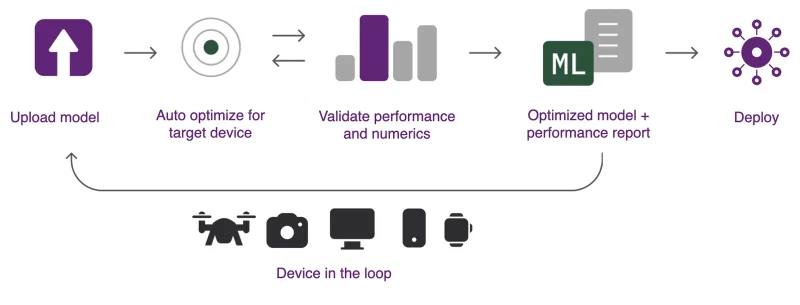
The second half of the service is measurement. A developer uploads a trained model, the hub compiles it for a chosen chip and runtime, then runs it on a physical Snapdragon device in Qualcomm’s cloud and returns latency, memory use and a numerical check against the original, as the documentation describes. The same measurements are published for every catalogue entry, which is why each model page names the handset the figures came from.
At launch the export recipes in Qualcomm’s repository covered two runtimes, TensorFlow Lite and Qualcomm AI Engine Direct, on Android 11 and newer, in FP16, INT8 and INT4. The supported chips ran from the Snapdragon 845 through the Snapdragon 888 to the Snapdragon 8 Gen 3, with Samsung Galaxy S21 to S24, Xiaomi 12 and 13 and Google Pixel 3 to 5 handsets named as targets. Everything is driven from a Python package called qai_hub.
Two of the listed models generate text, Llama-v2-7B-Chat and Baichuan-7B, both quantised to 4-bit weights and 16-bit activations. Qualcomm’s model card puts Llama-v2-7B-Chat at 3.6 GB with a maximum context of 1024 tokens, and reports it measured on a Samsung Galaxy S23 Ultra running Android 13 on a Snapdragon 8 Gen 2, on the NPU, at 117.8 ms for each additional token and 2,578.5 ms to push a full 1024-token prompt through before the first token comes back. Peak memory for the token generator is 66 to 238 MB.
Qualcomm publishes the models on the AI Hub site, on GitHub and on Hugging Face, and names no price for the service, asking only for a Qualcomm ID to sign in and an API token to submit jobs. The licensing is layered. Qualcomm’s export and optimisation code is BSD 3-Clause, each model keeps the licence of the original implementation, so Llama-v2-7B-Chat stays under Meta’s terms, and the compiled assets prepared for on-device deployment carry a separate Qualcomm AI Hub Proprietary License.