Qualcomm and Meta ran an ExecuTorch hackathon where an offline survival app won

Lodestar, an offline survival app that requests no internet permission at all, won the ExecuTorch hackathon that Qualcomm and Meta held in San Francisco on June 27 and 28, 2026. The official results name it the single champion among 22 projects, which lablab.ai reports came from 65 teams and 372 participants.
The app covers three jobs for the case where GPS and networks fail. According to the team’s write-up, severity in its first-aid triage comes from a deterministic safety-tree engine rather than from the language model, a solar compass finds true north by day, and on-device star plate-solving matches a photographed sky against a catalog by night. A status strip labels where the current position estimate comes from, with states such as GPS_TRUSTED, DEAD_RECKONING and STAR_FIX. The team says its safety tree, solar math and spoof detection pass automated tests, while corpus coverage and runtime integration are still in progress, and the code is on GitHub.
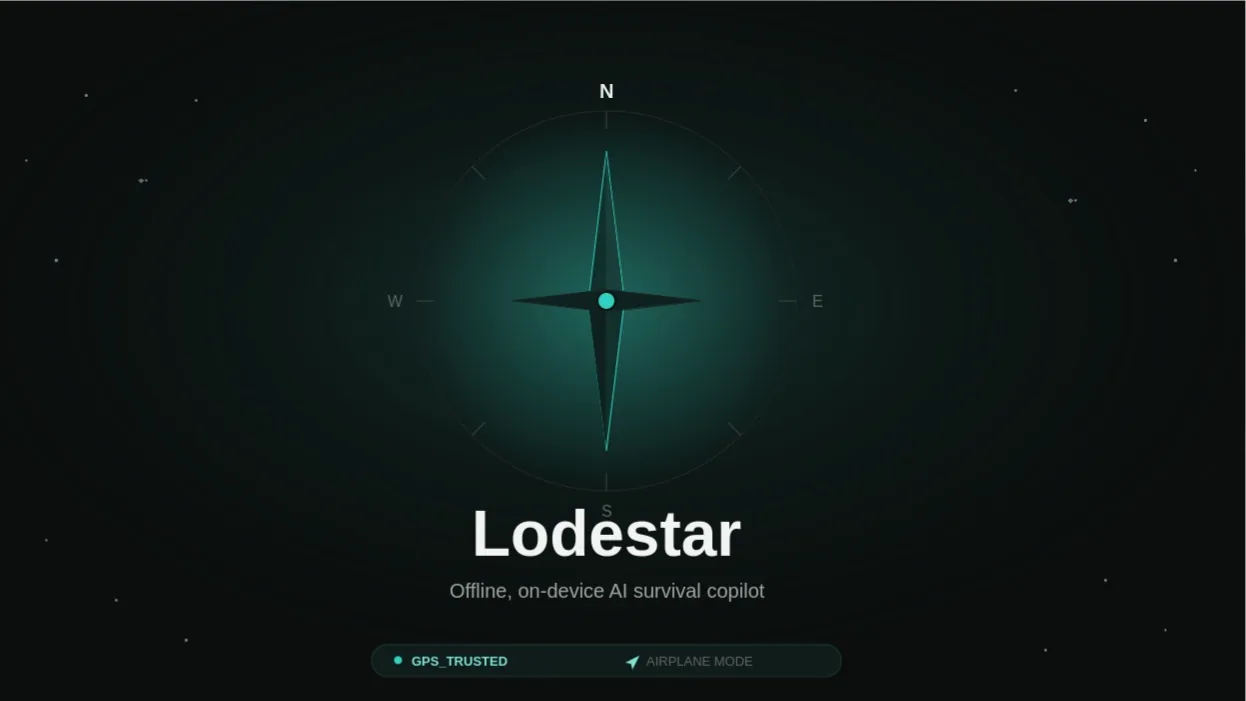
The status strip names which source the app is using for the current position estimate.Lodestar / lablab.ai
Entrants built against ExecuTorch on Snapdragon and received Samsung Galaxy S25 Ultra handsets on loan on site, which the organizers collected again before final judging. Judging criteria included technical implementation (NPU use, latency and energy efficiency), use case and innovation, and local processing and privacy; lablab publishes no percentage weights for them. Every submission had to ship a public GitHub repository with a README and an open-source license. The top award was a Meta Quest 3 for each member of the winning team, with Ray-Ban Meta AI glasses going to the team chosen by participant vote.
Two further entries placed in the participant vote without winning it. SixthSense turns a phone camera into directional buzzes on a belt for blind and low-vision users, running YOLOv11n for detection, Depth-Anything-V2 for distance and Qwen2.5-0.5B for spoken questions through ExecuTorch on a Snapdragon 8 Elite, with the option to run on the Hexagon NPU. Its team puts the belt under $20 against $850 to $2,000 for smart canes and glasses. Toddle AI analyzes toddler walking videos on an Android phone with a 33-landmark pose model and a deterministic gait pipeline, and its team calls it a research prototype rather than a clinical diagnostic tool.