Hugging Face releases SmolLM at 135M, 360M and 1.7B parameters
Hugging Face released SmolLM on July 16, 2024, a family of three base models at 135M, 360M and 1.7B parameters. The team says the models are designed to be small enough to run locally across a range of hardware, from smartphones to laptops, and cites the iPhone 15 with 6 GB of DRAM and the iPhone 15 Pro with 8 GB as reference points. Hugging Face trained the 135M and 360M models on 600B tokens each and the 1.7B model on 1T tokens.
The substance is the training data, released as SmolLM-Corpus. Cosmopedia v2 contributes 28B tokens of synthetic textbooks, stories and articles generated by Mixtral-8x7B-Instruct, 39 million documents built from a predefined list of 34,000 topics taken from the BISAC book classification instead of from unsupervised clustering. FineWeb-Edu contributes 220B deduplicated tokens of educational web pages, pulled out of FineWeb by a quality classifier trained on annotations from Llama3-70B-Instruct. Python-Edu applies the same idea to code, keeping 4B tokens of the 40B Python tokens in The Stack that scored 4 or higher on an educational code classifier.
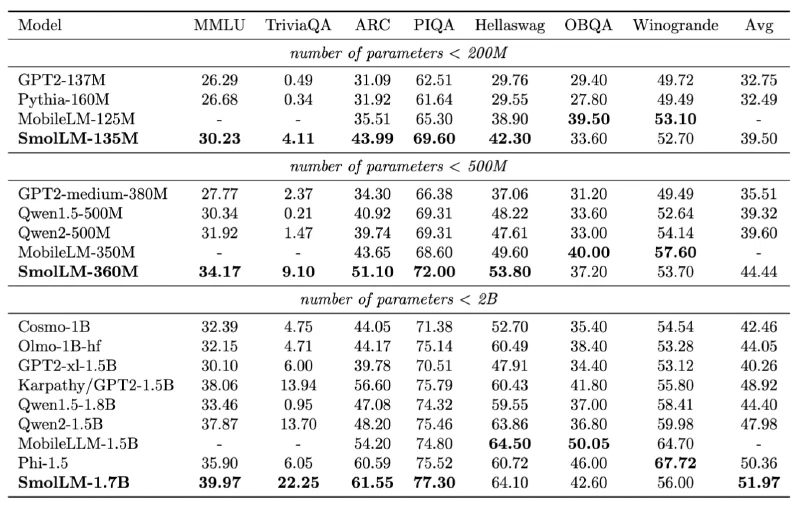
On Hugging Face’s own evaluation, run with the same lighteval setup for every model it could download, SmolLM-135M averages 39.50 across MMLU, TriviaQA, ARC, PIQA, HellaSwag, OpenBookQA and Winogrande, against 32.75 for GPT2-137M and 32.49 for Pythia-160M. SmolLM-360M averages 44.44 against 39.60 for Qwen2-500M and 39.32 for Qwen1.5-500M, and SmolLM-1.7B averages 51.97 against 50.36 for Microsoft’s Phi-1.5 and 47.98 for Qwen2-1.5B. Meta’s MobileLLM is not publicly available, so Hugging Face took its per-benchmark numbers from the paper and reports no average for those rows.
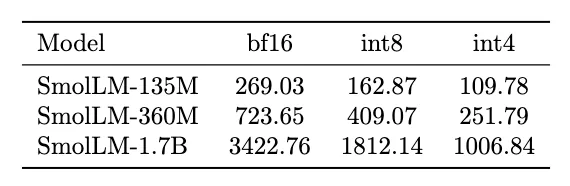
Hugging Face also benchmarked the memory footprint of each size. SmolLM-135M takes 269.03 MB in bf16, 162.87 MB at int8 and 109.78 MB at int4. SmolLM-360M takes 723.65 MB, 409.07 MB and 251.79 MB across the same three precisions, and SmolLM-1.7B takes 3422.76 MB, 1812.14 MB and 1006.84 MB.
The weights are on Hugging Face under Apache-2.0, with ONNX checkpoints published beside the transformers ones and a GGUF build for llama.cpp announced as planned. Hugging Face also put up browser demos of the instruction-tuned 135M and 360M models that run client-side through WebGPU, with no server call. The corpus is released separately under ODC-By.