Hugging Face's SmolLM3 is a 3B model with 128k context and two reasoning modes
Hugging Face released SmolLM3 on July 8, 2025, a 3B model trained on 11.2 trillion tokens that takes up to 128k tokens of context, covers six languages and answers in either of two modes. It is the successor to SmolLM2, whose largest model was 1.7B with an 8k context window and, in Hugging Face’s own words, primarily understands and generates content in English.
The longer context comes from an architecture change plus a separate training stage. Hugging Face removed rotary position embeddings from every fourth layer, a technique it calls NoPE, and replaced multi-head attention with grouped-query attention to shrink the key-value cache during inference. After the main pretraining run it trained the model on another 100 billion tokens in two steps, 4k to 32k and then 32k to 64k, and YaRN, a method for extrapolating past the trained length, carries it to 128k tokens at inference, though the published configuration ships set to 64k and has to be edited to go further. Multilingual text made up 12 percent of the web data at every pretraining stage, and Hugging Face lists English, French, Spanish, German, Italian and Portuguese as supported.
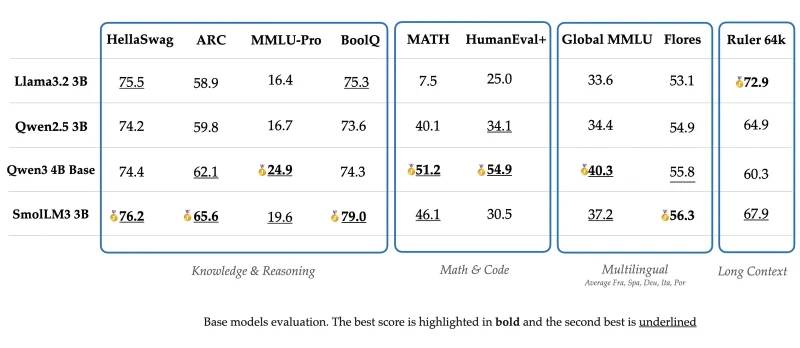
Hugging Face’s own base-model figures put SmolLM3 at 76.2 on HellaSwag, 65.6 on ARC and 79.0 on BoolQ, ahead of both Llama 3.2 3B and Qwen2.5 3B and ahead of the larger Qwen3 4B on all three. Qwen3 4B stays in front on maths and code, at 51.2 against 46.1 on MATH and 54.9 against 30.5 on HumanEval+, and on the Ruler 64k long-context test Llama 3.2 3B leads at 72.9 against 67.9 for SmolLM3. On the Flores-200 translation benchmark SmolLM3 scores 56.3 against 55.8 for Qwen3 4B and 54.9 for Qwen2.5 3B, and its multilingual chart shows it ahead of both 3B rivals in all five non-English languages and behind Qwen3 4B in all five.
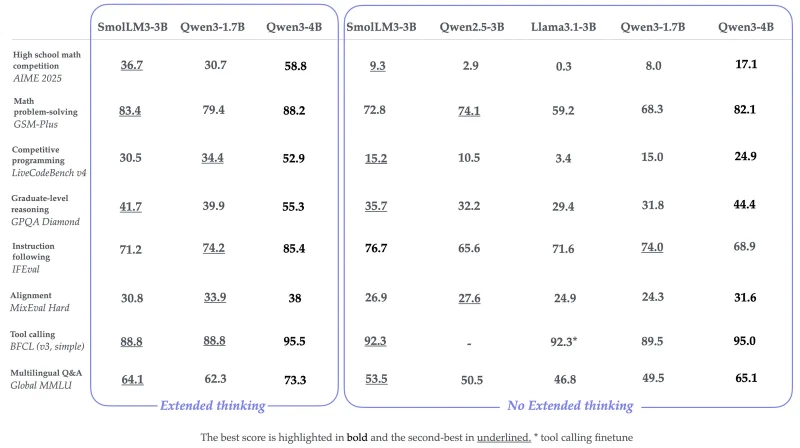
A flag in the system prompt, /think or /no_think, decides whether the instruct model reasons before it answers. Hugging Face reports the reasoning mode at 36.7 percent on the AIME 2025 maths competition against 9.3 percent without it, 41.7 against 35.7 on GPQA Diamond and 30.5 against 15.2 on LiveCodeBench v4. Qwen3 4B leads on most of the eight tests in that comparison in both modes, at 58.8 on AIME 2025 and 52.9 on LiveCodeBench, though SmolLM3 without reasoning tops it on the IFEval instruction-following test at 76.7 to 68.9.
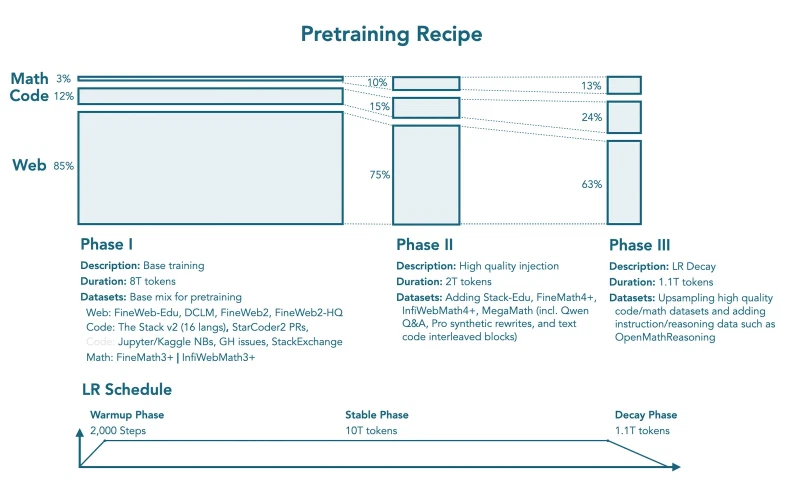
Hugging Face published the recipe as well as the weights. Pretraining ran in three stages that moved web data from 85 percent to 75 and then 63 percent while code rose from 12 percent to 24 and maths from 3 percent to 13, each share drawn from named public datasets, and the company released the training configs with the exact data weights along with intermediate checkpoints. Both the base and instruct models are on Hugging Face under the Apache 2.0 license, and the model card names llama.cpp, ONNX, MLX, MLC and ExecuTorch for local inference. The 4-bit GGUF published by ggml-org on release day is 1.92 GB, against 3.27 GB for the 8-bit build for MLX and 6.15 GB for the bfloat16 weights.