Qualcomm positions Snapdragon X2 as an agentic PC chip and previews Linux support
At Snapdragon Summit 2026 in Maui, Qualcomm framed the Snapdragon X2 Elite and X2 Elite Extreme, the laptop chips it launched a year earlier and has shipped since spring 2026, as the hardware for “agentic” PCs that run AI agents locally rather than answering single prompts. Qualcomm says updated configurations of the Hexagon NPU now reach up to 85 TOPS, up from the 80 TOPS specified at launch, on a platform with 228 GB/s of memory bandwidth. The company also claims up to twice the tokens per second of the first-generation Snapdragon X Elite, 450 supported on-device models, and models up to 30 billion parameters running locally with a 200,000-token context window.
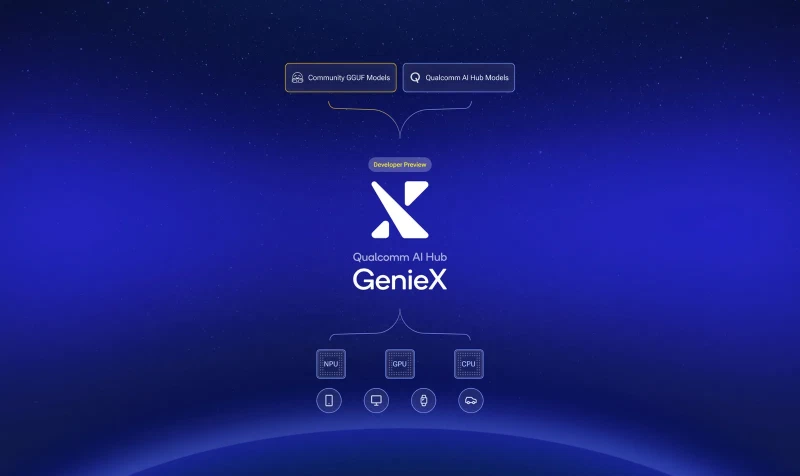
Much of that agent support runs through GenieX, an open-source, BSD-3-Clause inference runtime Qualcomm released in developer preview after acquiring Nexa AI earlier in 2026. GenieX accepts GGUF models from Hugging Face through llama.cpp, precompiled bundles from Qualcomm AI Hub, or a developer’s own model, and dispatches them across the Hexagon NPU, Adreno GPU or CPU. Developers reach it through a local server, a CLI, a Python SDK, Docker or Linux builds, or an Android interface. Qualcomm says AnythingLLM and LLMWare already run natively on Snapdragon X2, while OpenClaw runs directly on top of GenieX.
In its compute keynote at the summit, Qualcomm said its Concierge demo uses this dispatch model for tiered routing: Clairvoyance AI sends chat and simple requests to a 3B model, light tool use to a 9B model, and high-compute agentic work to a 27B model, all served locally on the Hexagon NPU through GenieX. These figures come from the keynote presentation rather than a published spec sheet, and Qualcomm did not disclose which 27B model it used, its quantization, the RAM configuration, context length, tokens per second or sustained thermals for that demo, so the on-device feasibility of the largest tier remains unverified.
One demo Qualcomm calls Creator pairs AnythingLLM with ON1 Photo RAW to search, organize and generate from a photo library using plain-language requests instead of manual tagging or folders. Qualcomm showed two further local-agent demos built with partners: a podcast assistant that uses Deepgram for real-time transcription, and a security agent built with Pokee and Halo for continuous monitoring and deepfake detection.
Running large models locally on a laptop currently means choosing between different platform approaches: Apple pairs its GPU with a large pool of unified memory, AMD’s Strix Halo chips do the same, Nvidia’s laptop GPUs run faster but are limited by fixed VRAM, and Qualcomm’s Snapdragon X2 leans on NPU-driven inference backed by its platform’s 228 GB/s of memory bandwidth rather than a larger GPU.
Qualcomm also published an early developer preview of Linux for Snapdragon X2 laptops, making Linux a third operating system option alongside Windows and Google’s Googlebook platform. The preview boots over UEFI, supports USB and PCIe, and drives the display and GPU through the open-source Freedreno, Turnip and Rusticl stack, while the Hexagon NPU is reachable through the FastRPC driver, running on a Debian 13 userspace with a custom-built kernel that developers have to compile themselves. Qualcomm targets foundational Debian support by the end of 2026, with Ubuntu certification and Linux laptops from HP, ASUS and HUMAIN planned for the first half of 2027. GenieX and the Linux preview are both available to developers now, though neither is consumer-ready, Microsoft’s Windows 11 26H1 update will be exclusive to Snapdragon X2 PCs, and the chips themselves have been shipping in laptops since spring 2026.